
Gradient Index Lens Optical Lenses
Description
Gradient Index (GRIN) lenses are optical lenses that focus light through continuous changes in the refractive index within the lens material. Unlike traditional lenses that rely on curved surfaces to bend light, GRIN lenses achieve focusing by gradually altering the refractive index from the center to the edge of the lens. This unique property allows GRIN lenses to be miniaturized and integrated into compact optical systems.
Working Principle
GRIN lenses work by continuously bending light rays within the lens until they converge at a focal point. This is achieved through a gradual change in the refractive index across the lens material, which contrasts with conventional lenses that primarily bend light abruptly at the lens surfaces. The ability to precisely control the refractive index gradient allows for significant flexibility in lens design, making GRIN lenses cost-effective and simple to employ in various optical systems.
Applications
GRIN lenses are used in a variety of applications due to their compact size and unique focusing properties. A specific example includes their use in compact endoscopic fiber probes for cancer diagnostics, where GRIN lenses help focus laser light in a miniaturized form factor, enabling the development of small, portable diagnostic devices .
Advantages over other Optical Lenses
One of the primary advantages of GRIN lenses over traditional optical lenses is their ability to be miniaturized while maintaining effective light focusing capabilities. This makes them particularly useful in applications where space is limited, such as in medical devices and compact imaging systems. Additionally, the continuous refractive index gradient allows for more precise control over light propagation, which can lead to improved optical performance in certain applications .
Limitations
While GRIN lenses offer several advantages, they also have limitations. The manufacturing process for GRIN lenses can be complex, and achieving the desired refractive index gradient requires precise control, which can increase production costs. Additionally, the materials used for GRIN lenses may have specific wavelength limitations, which can restrict their use in certain optical applications .
Considerations
When considering the use of GRIN lenses, it is important to evaluate factors such as initial costs, operating expenses, and durability. The precise manufacturing process can lead to higher initial costs compared to traditional lenses. However, the potential for miniaturization and integration into compact systems may offset these costs in applications where space and weight are critical. Durability and maintenance costs will depend on the specific materials used and the operating environment, as GRIN lenses may require careful handling to maintain their optical properties over time .
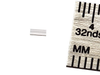
from Newport MKS
The LGI630-2 GRIN Lens has a 0.25-pitch lens that is useful for fiber coupling and collimating and fiber-to-fiber coupling. This SELFOC ® radial gradient index oxide glass general purpose plano-plano lens has a 1.0 mm diameter, a 2.58 mm length, a 0.46 NA, and is antireflection coated to... [See More]
- Lens Type: Gradient Index Lens
- Materials: SELFOC® radial gradient index oxide glass
- Diameter / Length: 1
- Lens Features: Antireflection Coating

from Thorlabs, Inc.
At Thorlabs, we constantly reinforce our desire to serve at the pleasure of our customers. From this comes our desire to be connected to our industry in a way that far exceeds what would typically be expected of a vendor. Thorlabs lives this core principle by seeking to enhance, at every turn, the... [See More]
- Lens Type: Gradient Index Lens
- Center Thickness: 4.26 to 5.59
- Focal Length: 1.85 to 1.99
- Diameter / Length: 1.8
from LightPath Technologies, Inc.
Gradium ® Lens, single lens replacement for conventional doublets [See More]
- Lens Type: Gradient Index Lens
- Center Thickness: 2.9
- Focal Length: 5
- Diameter / Length: 5