
80-50 Scratch / Dig Optical Lenses
Description
80-50 Scratch / Dig Optical Lenses are characterized by their surface quality, which is defined by the size and extent of surface defects such as scratches and digs. In this context, a scratch is a defect whose length is many times its width, while a dig is a defect that is nearly equal in length and width. The 80-50 rating indicates that the average diameter of the digs is 0.50 mm and the average length of a scratch is 0.80 mm .
Working Principle
The working principle of 80-50 Scratch / Dig Optical Lenses involves the control and management of surface imperfections to ensure optimal optical performance. The scratch and dig specifications are crucial for determining the smoothness and quality of the lens surface. These specifications are particularly important in applications where surface imperfections can lead to scattering of light or degradation of image quality. By maintaining a controlled level of surface defects, these lenses can effectively transmit light with minimal distortion, making them useful in various optical systems .
Applications
Specific applications for 80-50 Scratch / Dig Optical Lenses are not detailed in the provided documents. However, lenses with such specifications are generally used in environments where moderate surface quality is acceptable, and high precision is not the primary requirement. They might be employed in less demanding optical systems where cost-effectiveness is prioritized over the highest possible optical clarity.
Advantages over other Optical Lenses
The 80-50 Scratch / Dig Optical Lenses offer a balance between cost and performance. While they do not provide the superior surface quality of lenses with lower scratch/dig ratings (such as 10-5 or 20-10), they are more affordable and sufficient for applications where extreme precision is not necessary. This makes them advantageous in scenarios where budget constraints are a significant consideration, and the optical system can tolerate a higher level of surface imperfections .
Limitations
The primary limitation of 80-50 Scratch / Dig Optical Lenses is their relatively higher level of surface defects compared to lenses with lower scratch/dig ratings. This can result in increased light scattering and reduced image quality, making them unsuitable for high-precision applications such as advanced laser systems or high-resolution imaging where minimal surface imperfections are critical .
Considerations
When considering 80-50 Scratch / Dig Optical Lenses, it is important to weigh the initial costs against the performance requirements of the intended application. These lenses are generally more cost-effective than those with superior surface quality, but they may incur higher operating expenses if the application demands frequent replacements due to wear or damage from surface defects. Durability and maintenance costs should also be considered, as lenses with higher scratch/dig ratings may require more frequent cleaning and care to maintain their optical performance .
from CeNing Optics Co., Ltd.
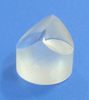
A Powell lens is used to generate a straight line with aspherical curvature on its apex, thereby outputting a line that has an even distribution of energy. For comparison, cylindrical lenses generate Gaussian beam profiles with hot-spot center points and fading edges. The uniformity of the output... [See More]
- Surface Quality: 80-50 Scratch / Dig
- Lens Application: Visible
- Lens Type: Aspheric; Powell
- Center Thickness: 7 to 9

from Gurley Precision Instruments
Aspheres minimize spherical aberrations, Broadband coatings are recommended for aspherical lenses [See More]
- Surface Quality: 80-50 Scratch / Dig
- Focal Length: 24
- Lens Type: Aspheric; Spherical Lens
- Center Thickness: 15.6
from Newport MKS
The AMPX010 is a Plano-Convex Infrared Lens made of AMTIR-1 material. It has a diameter of 25.4 mm and an effective focal length of 26.06 mm. AMTIR-1 is a synthetic material transmissive in the near to mid IR range (800 nm to 16 μm). Transmittance is approximately 70% over the entire range. [See More]
- Surface Quality: 80-50 Scratch / Dig; 80-50 scratch-dig
- Focal Length: 24.59
- Lens Type: Spherical Lens
- Center Thickness: 3.68

from Hangzhou Shalom Electro-optics Technology Co., Ltd.
Features: • Flat-concave structure optimized for light collimation and diverging at absolute conjugate ratios > 5:1. • Substrates made from high-purity CaF2 crystals with exceptionally wide transmission from UV to IR (180-8000 nm). • High laser damage threshold and thermal shock... [See More]
- Surface Quality: 80-50 Scratch / Dig
- Focal Length: -18
- Lens Application: Infrared; Ultraviolet
- Center Thickness: 2
from Edmund Optics Inc.
Used primarily in high efficiency illumination systems, aspheric condensers offer superior aberration correction. We provide these in low f/#s for higher light gathering efficiency in condensing, projecting, and other illumination applications. Our aspheric lenses are ground and polished on the... [See More]
- Surface Quality: 80-50 Scratch / Dig
- Focal Length: 9.45
- Lens Type: Aspheric
- Center Thickness: 3.8
from ECOPTIK (CHANGCHUN) LTD
Plano-convex lenses are positive focal length elements that have one spherical surface and one flat surface. These lenses are designed for infinite conjugate (parallel light) use or simple imaging in non-critical applications. These optic lenses are ideal for all-purpose focusing elements. [See More]
- Surface Quality: 10-5 Scratch / Dig; 20-10 Scratch / Dig; 60-40 Scratch / Dig; 80-50 Scratch / Dig
- Diameter / Length: 2 to 300
- Lens Type: Spherical Lens
- Materials: Sapphire; Optical Glass, Fused Silica
from Advanced Optics, Inc.
CUSTOM OPTICAL COMPONENTS. In addition to our in-stock optical mirrors and optical windows, Advanced Optics provides custom fabrication and free engineering services. Our capabilities allow us to: Drill holes. Produce beveled substrates. Fabricate custom sizes and shapes. Provide coated filters or... [See More]
- Surface Quality: 80-50 Scratch / Dig
- Lens Application: Infrared (optional feature); Visible (optional feature); Ultraviolet (optional feature)
- Lens Type: Spherical Lens
- Center Thickness: 5.7 to 6.35

from Fairfield Crystal Technology, LLC.
OPTICAL COMPONENT MANUFACTURING. Fairfield Crystal provides component manufacturing for your most challenging designs and applications. Combined with our expertise in crystal growth our component fabrication team is able to manufacture highly polished single crystal lenses, prisms, wedges,... [See More]
- Surface Quality: 10-5 Scratch / Dig; 20-10 Scratch / Dig; 40-20 Scratch / Dig; 60-40 Scratch / Dig; 80-50 Scratch / Dig
- Lens Application: Infrared; Visible; Ultraviolet
- Lens Type: Cylindrical Lens; Spherical Lens
- Materials: Calcium Fluoride; Zinc Selenide

from Thorlabs, Inc.
At Thorlabs, we constantly reinforce our desire to serve at the pleasure of our customers. From this comes our desire to be connected to our industry in a way that far exceeds what would typically be expected of a vendor. Thorlabs lives this core principle by seeking to enhance, at every turn, the... [See More]
- Surface Quality: 40-20 Scratch / Dig; 60-40 Scratch / Dig; 80-50 Scratch / Dig
- Lens Application: Infrared; Visible; Ultraviolet
- Lens Type: Aspheric
- Focal Length: -100 to 9.65
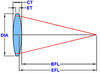
from Ross Optical Industries
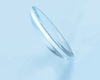
Bi-convex lenses have a positive focal length. Our catalog bi-convex lenses have an identical curvature on both sides of the lens and are therefore symmetric. At unit conjugation, coma and distortion cancel out due to the symmetry. They can be used to focus incoming light. [See More]
- Surface Quality: 80-50 Scratch / Dig
- Lens Application: Infrared (optional feature); Visible; Ultraviolet (optional feature)
- Lens Type: Spherical Lens
- Focal Length: 330
from Hangzhou Shalom Electro-optics Technology Co., Ltd.
Features: • One spherical side and one planar side are optimized for light collimation and focus at absolute conjugate ratios >5:1. • Substrates made from high-purity CaF2 crystals with exceptionally wide transmission from UV to IR (180-8000nm). • High laser damage threshold and... [See More]
- Surface Quality: 80-50 Scratch / Dig
- Focal Length: 20
- Lens Application: Infrared; Ultraviolet
- Center Thickness: 4.3

from Thorlabs, Inc.
At Thorlabs, we constantly reinforce our desire to serve at the pleasure of our customers. From this comes our desire to be connected to our industry in a way that far exceeds what would typically be expected of a vendor. Thorlabs lives this core principle by seeking to enhance, at every turn, the... [See More]
- Surface Quality: 10-5 Scratch / Dig; 20-10 Scratch / Dig; 40-20 Scratch / Dig; 60-40 Scratch / Dig; 80-50 Scratch / Dig
- Lens Application: Infrared; Visible; Ultraviolet
- Lens Type: Spherical Lens
- Focal Length: -1000 to 750
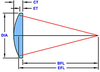
from Ross Optical Industries
These are lenses with one flat surface and one convex surface. They have a positive focal length and are used to converge or focus incoming light. They are best for infinite conjugate systems. They can be used in many different optical systems such as magnifiers, telescopes, collimators, condensers... [See More]
- Surface Quality: 80-50 Scratch / Dig
- Lens Application: Infrared (optional feature); Visible; Ultraviolet (optional feature)
- Lens Type: Spherical Lens
- Focal Length: 150