
λ/8 Optical Lenses

from ECOPTIK (CHANGCHUN) LTD
Achromatic Lenses are used to minimize or eliminate chromatic aberration. The achromatic design also helps minimize spherical aberrations. Achromatic Lenses are ideal for a range of applications, including fluorescence microscopy, image relay, inspection, or spectroscopy. An Achromatic Lens, which... [See More]
- Surface Flatness: λ/2; λ/4; λ/5; λ/8; λ/10
- Lens Application: Visible
- Lens Type: Achromats; Spherical Lens
- Focal Length: 50 to 2000

from EKSMA OPTICS
These lenses are symmetrical with equal radii on both sides. The biconcave lenses are often used to expand light beams or to increase focal lengths in optical systems, and are normally used in combination with other lenses. Among the many devices utilising biconcave lenses are laser beam expanders,... [See More]
- Surface Flatness: λ/8
- Focal Length: 12.5 to 500
- Lens Type: Cylindrical Lens
- Center Thickness: 1.7 to 4.8

from MOK Optics Co., Ltd.
Achromat is a lens consisting of two cemented elements made of different materials. The achromat lense offers superior correction of spherical aberration in monochromatic applications. [See More]
- Surface Flatness: λ/8
- Diameter / Length: 3 to 250
- Lens Type: Achromats
- Materials: Germanium; Sapphire; Ultra-violet grade Fused Silica; CDGM, SCHOTT, OHARA, HOYA, MgF2, CaF2, ZnSe, ZnS etc

from Fairfield Crystal Technology, LLC.
OPTICAL COMPONENT MANUFACTURING. Fairfield Crystal provides component manufacturing for your most challenging designs and applications. Combined with our expertise in crystal growth our component fabrication team is able to manufacture highly polished single crystal lenses, prisms, wedges,... [See More]
- Surface Flatness: λ/2; λ/4; λ/5; λ/8; λ/10; λ/20
- Lens Application: Infrared; Visible; Ultraviolet
- Lens Type: Cylindrical Lens; Spherical Lens
- Materials: Calcium Fluoride; Zinc Selenide
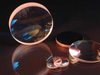
from Argyle International, Inc.
Argyle manufactures a wide variety of lenses. Custom designs including odd shapes, sections, and center holes are standard fare. Finish and accuracy from condenser to laser quality. Diameters from 0.5mm to 200mm. Surface finish to 10-5. Surface quality to 1/8 wave. Custom shapes. Spherical lenses. [See More]
- Surface Flatness: λ/8
- Diameter / Length: 0.5000 to 200
- Lens Type: Cylindrical Lens (optional feature); Spherical Lens (optional feature)
- Materials: BK7 Glass (optional feature); Crown Glass (optional feature); Flint Glass (optional feature); LaSFN9 Glass (optional feature); SF5 Glass (optional feature); SF11 Glass (optional feature); Calcium Fluoride (optional feature); Germanium (optional feature); Sapphire (optional feature); Zinc Selenide (optional feature); Ultra-violet grade Fused Silica (optional feature); Fused Silica, BaF2, Silicon
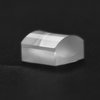
from ECOPTIK (CHANGCHUN) LTD
A cemented cylindrical lens can minimize chromatic aberration, so it can be used to focus a single direction of a multi-color light beam. Unlike a spherical lens that produces a point focusing spot, a cylindrical lens can produce a linear focusing spot. Our cylindrical achromatic doublets are... [See More]
- Surface Flatness: λ/2; λ/4; λ/5; λ/8; λ/10
- Focal Length: 50 to 2000
- Lens Type: Achromats; Spherical Lens
- Center Thickness: 2 to 50
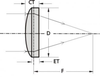
from EKSMA OPTICS
These simplest form lenses have flat surface on one side and spherical surface on the other. They are widely used in telescopes, microscopes, collimators, optical transceivers, magnifiers, condenser systems and eyepieces. Plano convex lens made of BK7, UV FS (UV grade Fused Silica), CaF2 (Calcium... [See More]
- Surface Flatness: λ/8
- Focal Length: 20 to 10000
- Lens Type: Cylindrical Lens
- Center Thickness: 2.1 to 12.3

from MOK Optics Co., Ltd.
MOK Optics provides various of germanium lenses upon customer requirements. The transmission of Ge is around 50% at 2-14 μm, we typically need to make AR coating for Ge optics, we can also make DLC coating (Diamond like carbon coating) for outdoor use. [See More]
- Surface Flatness: λ/8
- Diameter / Length: 3 to 250
- Lens Type: Spherical Lens
- Materials: Germanium

from ECOPTIK (CHANGCHUN) LTD
A cylindrical lens is typically used to focus, condense or expand incoming light. A cylindrical lens has one cylindrical surface, causing light to be focused in a single dimension or axis. It can also be used to expand the output of a laser diode into a symmetrical beam. Cylindrical lenses are... [See More]
- Surface Flatness: λ/2; λ/4; λ/5; λ/8; λ/10
- Lens Application: Visible
- Lens Type: Cylindrical Lens
- Diameter / Length: 2 to 200

from EKSMA OPTICS
These lenses are thicker at the edge than in the centre and flat on one side. The plano-concave lenses are used to expand light beams or to increase focal lengths in optical systems. They are often employed for beam expansion of high peak power pulsed lasers. A beam incident on a concave surface... [See More]
- Surface Flatness: λ/4; λ/8
- Focal Length: 25 to 5000
- Lens Type: Cylindrical Lens
- Center Thickness: 1.3 to 4.7
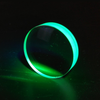
from ECOPTIK (CHANGCHUN) LTD
A double concave lens has negative focal length, thereby causing collimated incident light to diverge. Double concave lens has equal radius of curvature on both side of lens. They are generally used to expand light or increase focal length in existing system, such as beam expander and projection... [See More]
- Surface Flatness: λ/2; λ/4; λ/5; λ/8; λ/10
- Focal Length: -2000 to -50
- Lens Type: Spherical Lens
- Center Thickness: 2 to 20

from EKSMA OPTICS
Biconvex lenses are all symmetrical, having equal radii on both sides. They are recommended for virtual imaging of real objects, and for positive conjugate ratios from 0.2 up to 5. Outside of this ratios range plano-convex lenses are usually more suitable. Biconvex lenses are used as magnifiers,... [See More]
- Surface Flatness: λ/8
- Focal Length: 12.7 to 1000
- Lens Type: Cylindrical Lens
- Center Thickness: 2.2 to 16.2
from ECOPTIK (CHANGCHUN) LTD
The double convex lens is symmetrical across both its horizontal and vertical axis. Each of the lens' two faces can be thought of as originally being part of a sphere. The fact that a double convex lens is thicker across its middle is an indicator that it will converge rays of light that travel... [See More]
- Surface Flatness: λ/2; λ/4; λ/5; λ/8; λ/10
- Focal Length: 50 to 2000
- Lens Type: Spherical Lens
- Center Thickness: 2 to 20