
Ultraviolet Optical Lenses
Description
Ultraviolet optical lenses are specialized lenses designed to transmit ultraviolet (UV) light, which falls within the wavelength range of 4 to 380 nm. These lenses are crafted from materials that allow UV light to pass through while minimizing absorption and scattering, ensuring that the UV light can be effectively utilized in various optical systems.
Working Principle
Ultraviolet optical lenses work by collecting and focusing UV light onto an image sensor or other detection devices. The lenses are made from materials such as fused silica, barium fluoride, calcium fluoride, and lithium fluoride, which have low absorption in the UV range. These materials are selected for their ability to transmit UV light efficiently, despite their generally low refractive indices. The design of UV lenses often involves correcting chromatic aberration, which is a challenge due to the limited selection of UV optical materials and their small dispersion coefficients. Some UV lenses use a reflective optical system to better manage chromatic aberration compared to refractive systems.
Applications
Ultraviolet optical lenses have a wide range of applications, including ultraviolet astronomy, where they are used to observe celestial objects in the UV spectrum. They are also employed in sky communications and fire monitoring, where detecting UV light can provide critical information. Environmental monitoring utilizes UV lenses to detect and analyze pollutants and other environmental factors. In military applications, UV lenses are used for early warning systems, taking advantage of their ability to detect UV signatures that are not visible to the naked eye.
Advantages over other Optical Lenses
Ultraviolet optical lenses offer specific advantages over visible and infrared lenses in applications that require the detection and analysis of UV light. For instance, they can capture images and data that are invisible to the human eye and standard optical systems, providing unique insights in fields like astronomy and environmental science. The ability to correct chromatic aberration more effectively with reflective systems also sets them apart in terms of image quality in certain applications.
Limitations
One of the primary limitations of ultraviolet optical lenses is the difficulty in manufacturing due to the limited availability of suitable optical materials. Many of these materials, such as the fluorides, are hygroscopic and require careful handling and assembly, often necessitating nitrogen purging to prevent moisture damage. Additionally, the low refractive indices of these materials can lead to increased lens thickness and reduced transmittance, which can partially offset the benefits of a large relative aperture.
Considerations
When considering ultraviolet optical lenses, it is important to account for the initial costs associated with the specialized materials and manufacturing processes required. Operating expenses may include maintenance of the optical system to prevent moisture damage and ensure optimal performance. Durability can be a concern due to the hygroscopic nature of some materials, which may affect the longevity of the lenses. Accuracy in UV imaging is highly dependent on the quality of chromatic aberration correction and the design of the optical system. Replacement and maintenance costs should also be considered, as the specialized nature of UV lenses may require more frequent servicing and careful handling compared to standard optical lenses.
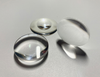
from Changchun Yutai Optics Co., Ltd.
BK7 is a common borosilicate optical glass developed by Schott . It has excellent optical and mechanical properties and is widely used in the manufacture of optical components. Refractive index: 1.5168 (at 587.6 nm). Abbe number: 64.2. Transmission range: approx. 350 nm to 2.0 µm. What is BK7... [See More]
- Lens Application: Ultraviolet
- Surface Quality: 40-20 Scratch / Dig
- Materials: BK7 Glass; Ultra-violet grade Fused Silica
- Surface Flatness: λ/4
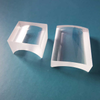
from Changchun Yutai Optics Co., Ltd.
K9 cylindrical lenses are optical components that are commonly used in lasers, imaging and optical systems. What are the applications of K9 cylindrical lenses?. Laser systems: for beam shaping, beam expansion or focusing. Imaging systems: to correct dispersion or to realize specific optical effects. [See More]
- Lens Application: Infrared; Visible; Ultraviolet
- Materials: BK7 Glass
- Lens Type: Cylindrical Lens
- Surface Quality: 40-20 Scratch / Dig
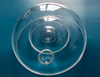
from Changchun Yutai Optics Co., Ltd.
The fused silica dome is a high performance optical protection element for scenarios where UV, high temperature, chemical corrosion, high power lasers, low thermal expansion and high transmittance are required. Yutai Optics recommends the use of fused silica JGS1. What are the applications of fused... [See More]
- Lens Application: Ultraviolet
- Surface Quality: 40-20 Scratch / Dig
- Materials: Ultra-violet grade Fused Silica
- Surface Flatness: λ/4
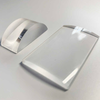
from Changchun Yutai Optics Co., Ltd.
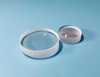
Fused silica has good transmission in the ultraviolet (UV), visible (VIS), and near-infrared (NIR) wavelengths, and especially excels in the deep ultraviolet (DUV) wavelengths. Fused silica has an extremely low coefficient of thermal expansion, making it suitable for high temperatures or... [See More]
- Lens Application: Ultraviolet
- Materials: Ultra-violet grade Fused Silica
- Lens Type: Cylindrical Lens
- Surface Quality: 40-20 Scratch / Dig
from Changchun Yutai Optics Co., Ltd.
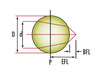
Fused silica balls are high performance optics for scenarios where ultraviolet, high temperatures, chemical corrosion, high power lasers, low thermal expansion and high transmittance are required. Selection requires a trade-off between performance and cost based on specific needs. What are the... [See More]
- Lens Application: Ultraviolet
- Materials: BK7 Glass; Ultra-violet grade Fused Silica
- Lens Type: Ball
- Surface Quality: 40-20 Scratch / Dig
from Changchun Yutai Optics Co., Ltd.
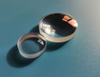
What is UV Fused Silica Lenses?. UV Fused Silica Lens is an optical lens made from fused silica, Yutai offers different fused silica material:Chinese fused silica: JGS1, JGS2, JGS3 and Corning 7980, Corning 7979. What is the application of UV Fused Silica Lenses?. Fused silica lenses play an... [See More]
- Lens Application: Ultraviolet
- Surface Quality: 40-20 Scratch / Dig
- Materials: Ultra-violet grade Fused Silica
- Surface Flatness: λ/4
from Changchun Yutai Optics Co., Ltd.
UV Grade BaF2 Lenses [See More]
- Lens Application: Ultraviolet
- Surface Quality: 40-20 Scratch / Dig
- Materials: BaF2
- Surface Flatness: λ/4

from ECOPTIK (CHANGCHUN) LTD
Optical dome is our company's superior product. In the past, most of the fairings were infrared grade, which were mostly used in military products. With the development of military-civilian integration, especially in visible materials and ultraviolet , we have become one of the best optical... [See More]
- Lens Application: Infrared; Ultraviolet
- Center Thickness: 1 to 8
- Lens Type: Dome Lens
- Diameter / Length: 10 to 230

from Suzhou Sujing Crystal Element Co.,Ltd
Used for precision measuring instrument probe, high pressure pump, liquid chromatography and valve ball, bearing for ball, pen bead, etc [See More]
- Lens Application: Infrared; Visible; Ultraviolet
- Materials: Sapphire
- Lens Type: Ball
from Edmund Optics Inc.
Creates a Ring Shaped Approximation of a Bessel Beam. Available Uncoated or Anti-Reflection Coated. Offered in a Variety of Apex Angles. Plano-Convex (PCX) Axicons feature one conical surface and one plano surface. They are used to produce a non-diffractive ring-shaped beam that increases in... [See More]
- Lens Application: Ultraviolet
- Center Thickness: 9.4
- Lens Type: Aspheric
- Edge Thickness: 3.5

from Fairfield Crystal Technology, LLC.
OPTICAL COMPONENT MANUFACTURING. Fairfield Crystal provides component manufacturing for your most challenging designs and applications. Combined with our expertise in crystal growth our component fabrication team is able to manufacture highly polished single crystal lenses, prisms, wedges,... [See More]
- Lens Application: Infrared; Visible; Ultraviolet
- Materials: Calcium Fluoride; Zinc Selenide
- Lens Type: Cylindrical Lens; Spherical Lens
- Surface Quality: 10-5 Scratch / Dig; 20-10 Scratch / Dig; 40-20 Scratch / Dig; 60-40 Scratch / Dig; 80-50 Scratch / Dig

from Thorlabs, Inc.
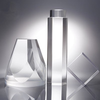
At Thorlabs, we constantly reinforce our desire to serve at the pleasure of our customers. From this comes our desire to be connected to our industry in a way that far exceeds what would typically be expected of a vendor. Thorlabs lives this core principle by seeking to enhance, at every turn, the... [See More]
- Lens Application: Infrared; Visible; Ultraviolet
- Focal Length: -100 to 1000
- Lens Type: Achromats
- Center Thickness: 1.5 to 7.9
from Changchun Sunday Optics Co., Ltd.
Calcium fluoride has a high transmittance from ultraviolet to mid-infrared (250nm~7um), so it is widely used in the manufacture of prisms, Windows and lenses, In some applications with a wide spectrum range, it can be used directly without coating film, Especially, it has low absorption and high... [See More]
- Lens Application: Infrared; Ultraviolet
- Surface Flatness: λ/4
- Surface Quality: 40-20 Scratch / Dig
from HG Optronics, Inc.
A Plano-Convex lens causes light to focus to a point,it has a positive focal length,which is ideal for light collimation or for focusing applications utilizing monochromatic illumination, in a range of industries. HG OPTRONICS offers Plano-Convexlenses with a variety of coating options. 1.1. What is... [See More]
- Lens Application: Ultraviolet
- Focal Length: 8 to 250
- Lens Type: Spherical Lens
- Diameter / Length: 6 to 25.4
from Knight Optical (UK) Ltd
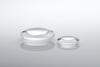
Biconvex lenses are a good quality simple form of lens; typically both faces are convex and spherical. UV grade fused silica biconvex lenses are widely used for moderate quality imaging and also for focussing and control of laser beams in UV applications. Generally biconvex lenses have the same... [See More]
- Lens Application: Ultraviolet
- Center Thickness: 0.2000
- Focal Length: 12.7
- Edge Thickness: 0.2000

from Intrinsic Crystal Technology Co., Ltd. (ICC)
A cylindrical lens is typically used to focus, condense or expand incoming light. A cylindrical lens has one cylindrical surface, causing light to be focused in a single dimension or axis. It can also be used to expand the output of a laser diode into a symmetrical beam. ICC supply various kinds... [See More]
- Lens Application: Infrared; Visible; Ultraviolet
- Diameter / Length: 1.2 to 350
- Lens Type: Cylindrical Lens; Meniscus
- Materials: BK7 Glass; Calcium Fluoride; Ultra-violet grade Fused Silica; Silicon, Other

from Hangzhou Shalom Electro-optics Technology Co., Ltd.
Features: • Flat-concave structure optimized for light collimation and diverging at absolute conjugate ratios > 5:1. • Substrates made from high-purity CaF2 crystals with exceptionally wide transmission from UV to IR (180-8000 nm). • High laser damage threshold and thermal shock... [See More]
- Lens Application: Infrared; Ultraviolet
- Surface Flatness: λ/4
- Diameter / Length: 12.7 to 25.4

from Shanghai Optics
An achromatic lens, often called an achromat, is a type of optical lens capable of correcting chromatic aberration, a distortion that occurs when glass splits white light into multiple colorwavelengths in the spectrum. Chromatic aberration is a common type of imaging defect. When white light passes... [See More]
- Lens Application: Ultraviolet
- Lens Type: Achromats
from Zygo Corporation
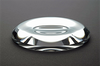
Aspheres – precision aspherical optics manufactured by ZYGO's Optics business segment – can be manufactured in sizes up to 500 mm, with tolerances better than λ/5000 RMS @ 633 nm. In the digital age, aspheres are growing in popularity in modern optical lens designs. Aspheric... [See More]
- Lens Application: Infrared; Visible; Ultraviolet
- Diameter / Length: 500
- Lens Type: Aspheric
- Materials: Calcium Fluoride; Zerodur, ULE, Glass, Ceramics, Si, CaF2

from Suzhou Jiujon Optics Co., Ltd
Laser-grade plano-convex lenses are among the most commonly used optical components in a wide range of applications requiring control of laser beams. These lenses are commonly used in laser systems for beam shaping, collimation, and focusing to achieve specific results, such as cutting or welding... [See More]
- Lens Application: Ultraviolet
- Materials: Ultra-violet grade Fused Silica
- Lens Type: Cylindrical Lens
- Surface Quality: 40-20 Scratch / Dig
from ECOPTIK (CHANGCHUN) LTD
Rod Lenses are polished on the circumference and ground on both ends. Optical performance is similar to a cylinder lens. Collimated light passing through the diameter of the rod lens will be focused into a line. optical glass and UV Fused Silica substrates are available for a variety of UV, Visible... [See More]
- Lens Application: Infrared; Visible; Ultraviolet
- Materials: Ultra-violet grade Fused Silica; Optical Glass
- Lens Type: Cylindrical Lens

from Thorlabs, Inc.
At Thorlabs, we constantly reinforce our desire to serve at the pleasure of our customers. From this comes our desire to be connected to our industry in a way that far exceeds what would typically be expected of a vendor. Thorlabs lives this core principle by seeking to enhance, at every turn, the... [See More]
- Lens Application: Infrared; Visible; Ultraviolet
- Focal Length: -100 to 9.65
- Lens Type: Aspheric
- Center Thickness: 0.8800 to 36

from Changchun Sunday Optics Co., Ltd.
Cylindrical lenses are generally used to focus incoming light onto a line or to change the aspect ratio of an image.They are usually linear and control the direction of the light beam.A cylindrical lens has a cylindrical surface that enables incident light to focus on a dimension and stretch the... [See More]
- Lens Application: Infrared; Ultraviolet
- Materials: Germanium; Sapphire; Optical glass, UVFS, Germanium, Silicon, CaF2, MgF2, ZnSe ZnS, Sapphire
- Lens Type: Spherical Lens
- Surface Quality: 10-5 Scratch / Dig

from Knight Optical (UK) Ltd
Calcium Fluoride (CaF ₂) is commonly used for optics looking at the IR and UV spectrums and has a very low change in refractive index with wavelength. It shares similar optical properties with Barium Fluoride although it has a transmission that is 2.5 µm less into the infra-red. Calcium... [See More]
- Lens Application: Ultraviolet
- Center Thickness: 0.2000
- Focal Length: 12.9
- Edge Thickness: 1.5

from Intrinsic Crystal Technology Co., Ltd. (ICC)
Glass domes are widely used for commercial applications which require protective boundary between different environments; domes perform as windows, providing protection to electronic sensors or detectors without sacrificing field of view. Composed of two parallel optical surfaces, domes have no... [See More]
- Lens Application: Infrared; Visible; Ultraviolet
- Materials: BK7 Glass; Sapphire; Ultra-violet grade Fused Silica; HP-MgF2/ZnS
- Lens Type: Dome
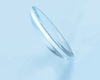
from Hangzhou Shalom Electro-optics Technology Co., Ltd.
Features: • One spherical side and one planar side are optimized for light collimation and focus at absolute conjugate ratios >5:1. • Substrates made from high-purity CaF2 crystals with exceptionally wide transmission from UV to IR (180-8000nm). • High laser damage threshold and... [See More]
- Lens Application: Infrared; Ultraviolet
- Materials: Calcium Fluoride; CaF2
- Diameter / Length: 12.7 to 25.4
- Surface Flatness: λ/4

from Zygo Corporation
ZYGO's Optics business segment manufactures precision spheres and lenses ranging in diameter from 50 mm to 200 mm with radii from 12.7 mm to 8 meters. Our standard product line of transmission spheres is available in 4" and 6" clear apertures ranging in f-numbers from f/.65 to f/11 with wavefront... [See More]
- Lens Application: Infrared; Visible; Ultraviolet
- Diameter / Length: 50 to 200
- Lens Type: Spherical Lens
- Radius of Curvature: 12.7 to 8000
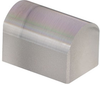
from Thorlabs, Inc.
At Thorlabs, we constantly reinforce our desire to serve at the pleasure of our customers. From this comes our desire to be connected to our industry in a way that far exceeds what would typically be expected of a vendor. Thorlabs lives this core principle by seeking to enhance, at every turn, the... [See More]
- Lens Application: Infrared; Visible; Ultraviolet
- Focal Length: -1000 to 1000
- Lens Type: Cylindrical Lens
- Center Thickness: 1.8 to 9.7
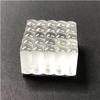
from Changchun Sunday Optics Co., Ltd.
A plano-concave lens is machined from a plane and a concave sphere.It has a negative focal length, which makes it widely used.In optical system, it is used for beam expansion, projection ray and extension of optical system focal length.Plane-concave lenses can diverge a collimating beam into a... [See More]
- Lens Application: Infrared; Ultraviolet
- Materials: H-K9L (Customization)
- Lens Type: Spherical Lens
- Surface Quality: 20-10 Scratch / Dig

from Thorlabs, Inc.
At Thorlabs, we constantly reinforce our desire to serve at the pleasure of our customers. From this comes our desire to be connected to our industry in a way that far exceeds what would typically be expected of a vendor. Thorlabs lives this core principle by seeking to enhance, at every turn, the... [See More]
- Lens Application: Infrared; Visible; Ultraviolet
- Focal Length: -1000 to 750
- Lens Type: Spherical Lens
- Center Thickness: 1.5 to 19.8
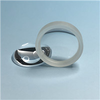
from Changchun Sunday Optics Co., Ltd.
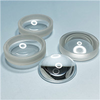
The roles of aspheric is to Simplify the system structure, shorten the tube length, reduce the weight of the system, improve the imaging quality, and make the optical system extend to the infrared and ultraviolet bands.With the development, , the cost of aspheric surface processing has been... [See More]
- Lens Application: Infrared; Ultraviolet
- Materials: Germanium; Sapphire; Optical glass, UVFS, Germanium, Silicon, CaF2, MgF2, ZnSe ZnS, Sapphire
- Lens Type: Spherical Lens
- Surface Quality: 10-5 Scratch / Dig
from Changchun Sunday Optics Co., Ltd.
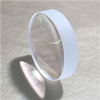
The roles of aspheric is to Simplify the system structure, shorten the tube length, reduce the weight of the system, improve the imaging quality, and make the optical system extend to the infrared and ultraviolet bands.With the development, , the cost of aspheric surface processing has been... [See More]
- Lens Application: Infrared; Ultraviolet
- Materials: Germanium; Sapphire; Optical glass, UVFS, Germanium, Silicon, CaF2, MgF2, ZnSe ZnS, Sapphire
- Lens Type: Spherical Lens
- Surface Quality: 10-5 Scratch / Dig
from Changchun Sunday Optics Co., Ltd.
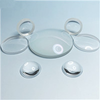
The roles of aspheric is to Simplify the system structure, shorten the tube length, reduce the weight of the system, improve the imaging quality, and make the optical system extend to the infrared and ultraviolet bands.With the development, , the cost of aspheric surface processing has been... [See More]
- Lens Application: Infrared; Ultraviolet
- Materials: Polycrystal CaF2, Singlecrystal CaF2
- Lens Type: Spherical Lens
- Surface Quality: 60-40 Scratch / Dig
from Changchun Sunday Optics Co., Ltd.
The roles of aspheric is to Simplify the system structure, shorten the tube length, reduce the weight of the system, improve the imaging quality, and make the optical system extend to the infrared and ultraviolet bands.With the development, , the cost of aspheric surface processing has been... [See More]
- Lens Application: Infrared; Ultraviolet
- Materials: Germanium; Sapphire; Optical glass, UVFS, Germanium, Silicon, CaF2, MgF2, ZnSe ZnS, Sapphire
- Lens Type: Spherical Lens
- Surface Quality: 10-5 Scratch / Dig