
Flying Prober / Scanner Automated Test Equipment
Description
Flying Prober Automated Test Equipment is designed to test printed circuit boards (PCBs) by using a small number of moving probes. These probes make contact with various test points on the PCB to evaluate its electrical performance and integrity.
Working Principle
The flying probe system operates by moving its probes across the PCB to make contact with specific test points. Unlike the bed-of-nails (BON) configuration, which uses a large number of fixed probes, the flying probe system uses fewer, movable probes. This allows for flexibility and adaptability in testing different board designs. The system is capable of providing nearly 100% test coverage on boards with thousands of nets and components, making it particularly useful for new product introductions where design changes are frequent. The ability to test without a fixed fixture makes it a versatile tool in the testing process.
Applications
Flying probe testing is particularly suited for small-volume production runs, prototyping, and complex PCBs. It is often used in scenarios where the design is still being finalized, or where the cost of creating a custom test fixture is prohibitive. This makes it ideal for industries that require rapid prototyping and testing, such as consumer electronics and aerospace.
Advantages over other Automated Test Equipment
One of the primary advantages of flying probe systems over traditional in-circuit testers (ICT) is their flexibility. They do not require custom test fixtures, which can be costly and time-consuming to produce. This makes flying probe systems more cost-effective for low to medium volume production. Additionally, they offer close to 100% test coverage, which is a significant advantage over some other testing methods that may not be able to test all components effectively.
Limitations
The main limitation of flying probe systems is their slower test times compared to fixed probe systems like the bed-of-nails configuration. This is due to the time it takes for the probes to move and make contact with each test point on the PCB. As a result, they may not be the best choice for high-volume production environments where speed is critical.
Considerations
When considering the use of flying probe systems, it is important to evaluate the initial costs, which are generally lower than those for systems requiring custom fixtures. Operating expenses are also typically lower due to the reduced need for fixture maintenance and replacement. However, the slower test times can impact throughput, which may affect overall production costs. Durability and accuracy are generally high, but regular maintenance is required to ensure the probes remain in good condition and continue to provide accurate test results.
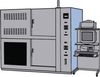
from CHINO Works America Inc.
The equipment is semiconductor aging testing equipment to full-automatically execute burn-in processing and data measurement/judgment/analytical processing and also has tester function as well as temperature accelerating testing. [See More]
- Interface: Floating Probe
- Component / Product Tested: MEMS or Electromechanical Devices; Passive Components; Loaded PCBs; Power Supplies or Transformers; Optoelectronics; Semiconductors or Active Components
- Type / Form: Platform or Turnkey System; Output Measurement or Monitoring Unit; Input Stimulus or Signal Source Unit; Fixture / Interface
- Tester / Test Capability: Life or Endurance Test; Functional