
IC Signal Generators Information
Last revised: November 15, 2024
Reviewed by: Scott Orlosky, consulting engineer
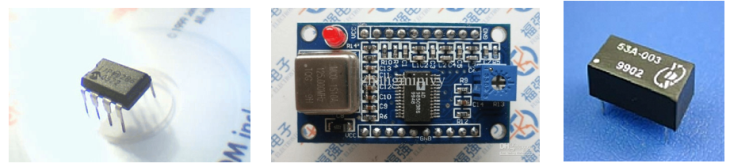
Image Credit: MySkunkWorks | dhGate.com | D and N Electronics, Inc
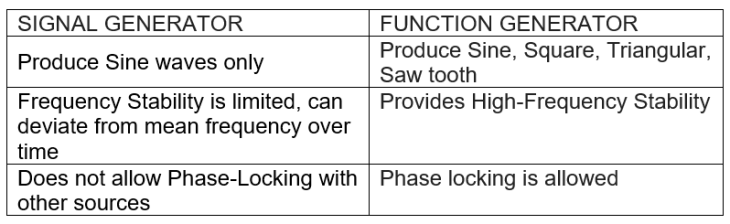
In broad outlines, waveform generators fall into the two categories of a Signal Generator and a Function Generator. The table below lists the general characteristics of these two waveform generator types.
Other terms such as synthesizers are used, but in general the two classification categories of signal generator and function generator can be applied to IC waveforms generators. An IC waveforms synthesizer (function generator) can generate different waveforms like sine, square, ramp, and triangle.
There are many different types of IC waveforms synthesizers. Examples include IC function generators, an IC waveform generator, arbitrary waveform generator, signal generator, and a sweep function generator. The sweep function generator is a common piece of audio test equipment to see how the design performs across the audio range from 20Hz to 20kHz.
An IC function generator is a versatile device that delivers a choice of different waveforms like sine, square, or triangle. The different waves can be obtained by selecting the appropriate code of the select pins which is present at the output. An IC waveform generator is an IC around which the waveform generator circuit is built. It is available as a bench top instrument, portable, or PC based module. One other function found on function generators is the ability to produce an arbitrary waveform. This allows the creation of any waveform at a wide range of amplitudes. An arbitrary signal generator is used to generate a specific waveform signal for testing and aligning all receivers and transmitters, and also for producing alternating current of desired frequency and amplitude. A sweep function generator adds the ability to generate different waveforms that may be required to measure the frequency response of amplifiers and filters, either through a linear, or a logarithmic sweep function. Other IC waveforms synthesizers are commonly available.
How They Function
There are several ways in which IC waveforms synthesizers function. A multifunction IC waveform synthesizer generates a sinewave in the frequency range of 0 to 600 kHz. The triangle, ramp, and square waves are generated at 0 to 50 kHz plus DC with 0.1Hz of resolution.
In an IC function generator, the output frequency can be controlled in the range from 0.1Hz to 20MHz and the duty cycle can be varied over a wide range when a ±2.3V control signal is applied. An arbitrary waveform generator is provided with 2 or 3 independent waveform channels and internal skew control. The precision at which waveforms are reproduced in an arbitrary waveform generator is the function of both horizontal and vertical resolutions.
Some examples of specifications of a signal generator include frequency range, frequency resolution, switching speed, and maximum input channels. IC waveforms synthesizers are designed and manufactured to meet most industry specifications.
Possible Applications
IC waveform synthesizers are used in many applications. Examples include automation, aerospace, and power supply meter testing. IC waveform synthesizers are also used in the medical field for patient monitoring equipment tests and biofeedback simulation.
Related Standards
- GOST 27072 — Audio Signal Diagnostic Generators. Audiometers. General Technical Requirements And Testing Methods
- FAA AC 170-6 — Use Of Radionavigation Land Test Station and Signal Generators
IC Signal Generators FAQs
What is the role of IC signal generators in communication systems?
IC signal generators provide the necessary signals for testing and evaluating various components and techniques. Here are some key roles they fulfill:
Generate signals that help in testing different modulation techniques. This is essential for ensuring that communication devices can effectively encode and decode information.
Simulate communication channels by recreating different transmission conditions. This allows engineers to evaluate the performance of communication systems under various scenarios, ensuring reliability and efficiency.
Digital modulation verification. This involves testing the accuracy and performance of digital modulation schemes.
These roles highlight the importance of IC signal generators in ensuring the functionality and performance of communication systems. They provide the necessary tools for testing, simulating, and verifying various aspects of communication technologies.
How are IC signal generators used in testing and measurement applications?
IC signal generators, particularly arbitrary function generators (AFGs), are used to evaluate the integrity of electrical signals as they travel through a system. This involves generating specific waveforms to test the system's response and ensure signal integrity. Here are the most common test and measurement functions.
Perform frequency response analysis by sweeping the frequency of the output signal. This helps measure the system’s response over a range of settings, which is crucial for understanding how different components react to various frequencies.
Distortion testing to gauge the performance and consistency of circuits and components. This type of testing is important at multiple stages of product development, including early design phases and post-production quality assurance.
Testing receivers and amplifiers by providing a library of common protocol signals and the flexibility to create custom formats. This helps in testing the limits of new designs and ensuring their performance.
IP3 measurement (gauges linearity in (RF) functions and components), radar testing, and other advanced testing scenarios. They help in evaluating the linearity and performance of communication systems and radar technologies.
Used for spurious and harmonics measurements, which are critical for ensuring linearity of electronic devices that meet industry standards and perform reliably in real-world conditions.
What is the importance of frequency response analysis (FRA) in testing and measurement?
Frequency response analysis is a critical aspect of testing and measurement and here's why it is important:
FRA helps in characterizing how a system responds to different frequencies. By sweeping the frequency of the output signal, engineers can measure the system's response over a range of settings, which helps in understanding the behavior of components like amplifiers and filters.
This analysis is essential for evaluating the performance and consistency of circuits and components. It allows engineers to identify any deviations or distortions in the system's response.
During the design phase, FRA aids in optimizing the design of electronic systems. By understanding how different components react to various frequencies, engineers can make informed decisions to improve the overall performance and functionality of the system.
FRA is used in quality assurance processes to ensure that products meet industry standards and perform reliably in real-world conditions. This type of testing is important at multiple stages of product development, including early design phases and post-production quality assurance.
What is the role of IC signal generators in testing modulation techniques?
IC signal generators produce signals that are essential for testing various modulation techniques. This ensures that communication devices can effectively encode and decode information, which is a fundamental aspect of communication systems.
Generators can simulate communication channels by recreating different transmission conditions. This allows engineers to evaluate the performance of communication systems under various scenarios.
In the context of digital communications, IC signal generators are used for digital modulation verification. This involves testing the accuracy and performance of digital modulation schemes, important for communication systems.
What is the importance of signal integrity testing in engineering?
Signal integrity testing is essential for evaluating the quality of electrical signals as they travel through a system. This involves assessing the signal's ability to maintain its intended shape and timing.
Through signal integrity testing, engineers can identify issues such as signal degradation, noise, and interference. This allows for the implementation of corrective measures to mitigate these problems, ensuring the system functions as intended.
Signal integrity testing helps in optimizing the performance of circuits and components. By understanding how signals behave within a system, engineers can make informed design decisions to enhance overall performance and efficiency.
This type of testing is a vital part of quality assurance processes. It ensures that products meet industry standards and perform reliably in real-world conditions - crucial for maintaining consumer trust and satisfaction.
Signal integrity testing is used in conjunction with other testing methods, such as frequency response analysis and distortion testing, to provide a comprehensive evaluation of electronic systems. This holistic approach is important for both early design phases and post-production quality assurance.
IC Signal Generators Media Gallery
References
Electronics360—New SSG5000X series 6 GHz RF analog/vector signal generators from Saelig
- ramp generator circuit
- frequency generator software
- AGV frequency generator
- portable frequency generators
- ultra high frequency generators
- 1 hz frequency generators
- 1ghz frequency generators
- 50 hz frequency generators
- bio solutions micro frequency generators
- extremely low frequency generators
- f165 frequency generators
- handheld frequency generators
- micro frequency generators
- multi frequency generators
- rotary pulse voltage frequency generators
- ultrasonic frequency generators
- USB programmable frequency generators