Practical Process Control for Engineers and Technicians
Temperature is the most common PV measured in process control. Due to the vast temperature range that needs to be measured (from absolute zero to thousands of degrees) with spans of just a few degrees and sensitivities down to fractions of a degree, there is a vast range of devices that can be used for temperature measurements.
The five most common sensors; thermocouples, resistance temperature detectors or RTDs, thermistors, IC sensors and radiation pyrometers have been selected for this chapter as they illustrate most of the application, range, accuracy and linearity aspects that are associated with temperature measurements.
Thermocouples cover a range of temperatures, from ?262 to +2760 C and are manufactured in many materials, are relatively cheap, have many physical forms, all of which make them a highly versatile device.
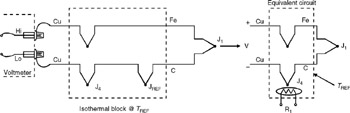
Thermocouples suffer from two major problems that cause errors when applying them to the process control environment.
The first is the small voltages generated by them, for example a 1 C temperature change on a platinum thermocouple results in an output change of only 5.8 ?V = (5.8 10 ?6 V).
The second is their non-linearity, requiring polynomial conversion, look up tables or related calibration to be applied to the signaling and controlling unit (see Figure 2.2).