Practical Process Control for Engineers and Technicians
Exercise 2: Proportional (P) Control Flow Chart

E.2.1 Objective

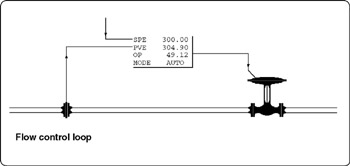
This exercise will introduce the main control action of controllers proportional control. Special emphasis is placed on the fact that there is a remaining offset condition, if proportional control is used solely. Figure Ex. 2.1 shows an example for closed loop control.


Ex. 2.1: Flow control loop

E.2.2 Operation

Call up the training application single flow loop. After this exercise has been called up, press F3 to get the detail display of the flow controller.

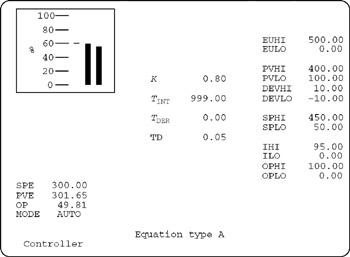
To prepare the controller for P-control only, change T INT (integral time constant) and T DER (derivative time constant). Set T INT to almost infinity. Set T DER to zero for no derivative action.

Practical values are 999 for T INT and 0 for T DER, as shown in Figure Ex. 2.2.


Ex. 2.2: Flow controller detail display for P-control

To study P-control, change SPE from 300 (60% of range) to 125 (25% of range).

E.2.3 Observation

It is observed, that the PVE value settles down before reaching the value of SPE. The remaining difference between SPE and PVE is called proportional offset. It can also be observed that the control action moves almost instantaneously (proportional control) in accordance with changes to PVE or SPE (equation type A). The trend display has to be observed very carefully (see Figure Ex. 2.3). The step change of SPE has caused the value of OP to make a step change accordingly. Immediately after this, one can observe...

UNLIMITED FREE
ACCESS
TO THE WORLD'S BEST IDEAS

SUBMIT
Already a GlobalSpec user? Log in.

This is embarrasing...

An error occurred while processing the form. Please try again in a few minutes.

Customize Your GlobalSpec Experience

Category: Flow Controllers
Finish!
Privacy Policy

This is embarrasing...

An error occurred while processing the form. Please try again in a few minutes.