Practical Process Control for Engineers and Technicians
Exercise 5: Introduction to Derivative (D) Control

E.5.1 Objective

This exercise will introduce the derivative control action of controllers. Derivative control action is required only in control loops with stability problems. Derivative control counteracts the instability (oscillation) of control loops. As such it is an additional control action. Derivative control is always combined to form a PD or PID-control loop system.

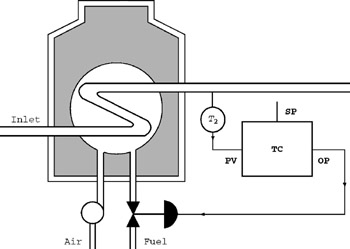
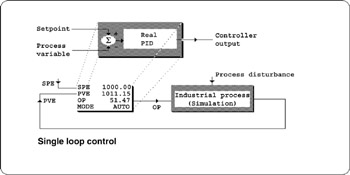
As flow loops generally have no stability problems, a general single loop is used to demonstrate D-control. Figure Ex. 5.1 shows a single loop to control temperature. This is an example for a control loop, where a stability problem can be expected. It would create unrealistic responses if we used derivative control in a flow control loop. A general control loop is shown in Figure Ex. 5.2.


Ex. 5.1: Feed heater single loop control

Ex. 5.2: Single loop control block diagram

E.5.2 Operation

Call up the training application general single loop with interactive PID (real form).

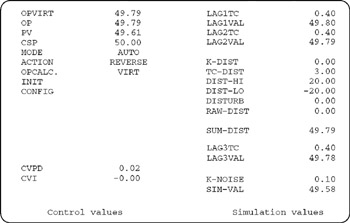
To confirm K-DIST is at 0, call up display F8 (auxiliary display). If necessary, change the gain for the disturbance to 0 (K-DIST = 0). It is important to be aware that some process noise still exists (K-NOISE = 0.1) (see Figure Ex. 5.3).


Ex. 5.3: Auxiliary display (F8)

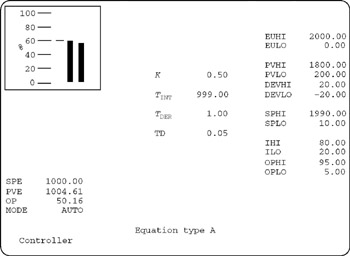
To study D-control alone, call up the detail display F3 and change K, T INT and T DER to the values shown in Figure Ex. 5.4.


Ex. 5.4: Controller detail display for D-control

In order to observe D-control, change SPE from approximately 1000 (50% of range) to approximately...

UNLIMITED FREE
ACCESS
TO THE WORLD'S BEST IDEAS

SUBMIT
Already a GlobalSpec user? Log in.

This is embarrasing...

An error occurred while processing the form. Please try again in a few minutes.

Customize Your GlobalSpec Experience

Category: Pressure Controllers
Finish!
Privacy Policy

This is embarrasing...

An error occurred while processing the form. Please try again in a few minutes.