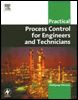
Practical Process Control for Engineers and Technicians
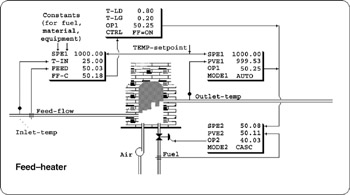
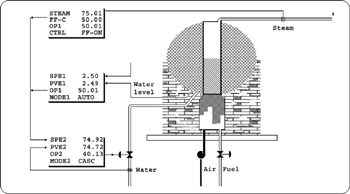
This exercise is provided to explore combined feedback and feedforward control. The intention of this section is to introduce this control strategy. Although it is not possible to go into all aspects of this topic in this exercise, the control of the training applications have not been simplified. The control examples provided are feedheater control (Figure Ex. 13.1) and boiler level control (Figure Ex. 13.2).
The main control is feedforward control, whenever all major disturbances are used to calculate feedforward control. In most cases, feedback control serves as a long term correction. In essence this means that it should act against the slow drift of the PV from the setpoint which feedforward cannot be expected to correct. Therefore, tuning should be done in the following order. Firstly, the flow controller which is common for feedback and feedforward control has to be tuned. Secondly, feedforward control and finally feedback control has to be tuned. The tuning of feedback control should aim towards minimum feedback control action, just enough to eliminate the process drift. Anything more adds to the wear and tear of equipment without significantly improving control results.
Combined feedforward and feedback control often makes use of one value in different places. If the operator or engineer is not aware of it, changes of those values may be made with one...