Practical Process Control for Engineers and Technicians
As a result of studying this chapter, and after having completed the relevant exercises, the student should be able to:
Select the correct PID-control algorithm for field interaction and for computer-optimized calculations
Clearly distinguish between process noise and control loop instability, which are often similar in appearance
List the correct sequence of steps to handle the different problems of noise and instability.
The ideal PID-controller is not suitable for direct field interaction, therefore it is called the non-interactive PID-controller. It is highly responsive to electrical noise on the PV input if the derivative function is enabled.
The real PID-controller is especially designed for direct field interaction and is therefore called the interactive PID-controller. Due to internal filtering in the derivative block the effects of electrical noise on the PV input is greatly reduced.
The non-interactive form of controller is the classical teaching model of PID algorithms. It gives a student a clear understanding of P, I and D control, since:
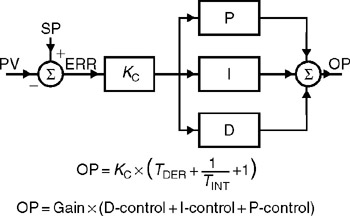
P-control, I-control and D-control can be seen independently of each other. Then, PID is effectively a combination of independent P, I and D-control actions. This can be seen in Figure 7.1.
Since P, I and D algorithms are calculated independently in an ideal PID-controller, this form of controller is recommended if an ideal process variable exists.
An ideal...