Practical Process Control for Engineers and Technicians
This chapter reviews the basic principles of process control. As a result of studying this chapter, and after having completed the relevant exercises, the student should be able to:
Clearly explain the concepts of:
On off control
Modulating control
Open loop control
Ratio control.
List the 10 most common acronyms and basic terminology used in the process control (e.g. PV, MV, OP).
Describe the differences between a reverse and a direct acting controller.
Indicate what deadtime is and how it impacts on a process.
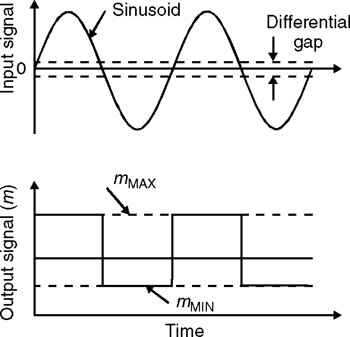
The oldest strategy for control is to use a switch giving simple on off control, as illustrated in Figure 4.1. This is a discontinuous form of control action, and is also referred to as two-position control. The technique is crude, but can be a cheap and effective method of control if a fairly large fluctuation of the process variable (PV) is acceptable.
A perfect on off controller is on when the measurement is below the setpoint (SP) and the manipulated variable (MV) is at its maximum value. Above the SP, the controller is off and the MV is a minimum.
On off control is widely used in both industrial and domestic applications. Most people are familiar with the technique as it is commonly used in home heating systems and domestic water heaters. Consider the control action on a domestic gas-fired boiler for example. When the temperature is below the setpoint, the fuel is...