Practical Process Control for Engineers and Technicians
The objective of this exercise is to provide some experience in Cascade control with multiple secondary controllers. Although various aspects are examined in some detail in this section, the software allows the student to explore other areas in more exhaustive detail.
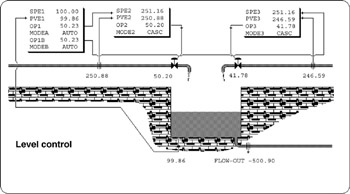
The application used in this exercise deals with cascade control, using two secondary controllers and one primary controller. In order to drive the setpoints of both secondary controllers independently from each other by the same primary controller, two independent OP calculations take place in the primary controller. These independent OP calculations result in two output values OPA and OPB of the primary controller and independent modes MODEA and MODEB (see Figure Ex. 12.1).
Generally, the amount of data for multiple outputs is too much for one display. As the primary controller in our training application has only two outputs, both are always displayed together on the same display. Viewing both outputs, their modes, alarms and initialization conditions on one screen is more useful in this (teaching) environment.
Call up the training application Tank level control with two inlets. Call the block diagram F2 and study the control concept without changing any values. Then, select trend display F4.
The training application is in a fully operational and stable automatic control status and correctly tuned when first retrieved. PVE2 and PVE3, the process variables of the two flow controllers, are approximately equal at the beginning although...