Practical Process Control for Engineers and Technicians
Chapter 5: Stability and Control Modes of Closed Loops

5.1 Objectives

As a result of studying this chapter, and after having completed the relevant exercises, the student should be able to:

  • Indicate what stability is, and mathematically what causes instability

  • Describe the function and use of proportional, integral and derivative control and various combinations of these terms

  • Indicate what problems in closed loop control are caused by and how to correct them.

5.2 The Industrial Process in Practice

We have seen the basic principles of closed loop control in the previous chapter. A control action is calculated, based on the deviation of the PV from the desired value of control as defined by the SP (ERR = PV-SP).

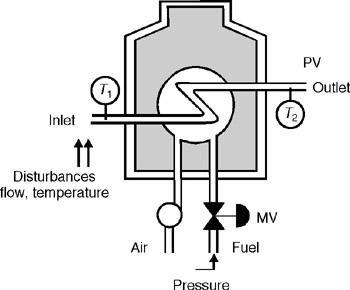
We have to consider the industrial process as it works in the real world. As an example of this, which we will now review, is a feed heater which is used to heat up material before it is fed into a distillation column (see Figure 5.1).


Figure 5.1: Temperature control of a feed heater

The objective of the system is temperature control of the outlet temperature ( T 2) that should be kept constant. The manipulated variable is the fuel valve position.

It should be noted, that for economic and environmental reasons, cross limiting control of the combustion is normally required to minimize the output of carbon monoxide. In this example for simplicity, we will neglect cross limiting control totally and manipulate the valve position directly.

This example of feed heater control will serve as an example for us to...

UNLIMITED FREE
ACCESS
TO THE WORLD'S BEST IDEAS

SUBMIT
Already a GlobalSpec user? Log in.

This is embarrasing...

An error occurred while processing the form. Please try again in a few minutes.

Customize Your GlobalSpec Experience

Category: Control Valves
Finish!
Privacy Policy

This is embarrasing...

An error occurred while processing the form. Please try again in a few minutes.