Practical Process Control for Engineers and Technicians
Exercise 7: Open Loop Method Tuning Exercise

E.7.1 Objective

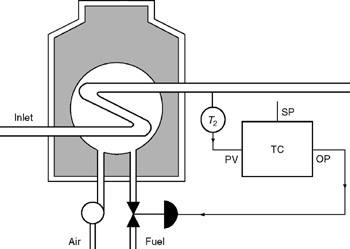
This exercise will give some practical experience in the reaction curve method of tuning. Figure Ex. 7.1 shows the diagram of a typical control loop. The steps for tuning are explained in Chapter 5, tuning of closed loop control systems .


Ex. 7.1: Single loop control

E.7.2 Operation

Call up the training application General single loop with interactive PID (real form).

Call up the detail display F3 and change MODE to MANUAL. Make a good judgment about the noise observed on the PV and set the digital noise filter (TD) accordingly. A good value of TD will result in a still noticeable but very small magnitude of noise on PV. The noise filter has to be set up before tuning in order to have it included in the result of tuning. From a practical point of view, the noise filter becomes part of the process as far as loop tuning is concerned. In this exercise, a good value for TD will be between 0.05 and 0.1.

Make a small change of OP, to find out how sensitive the process is in its response. Then wait until the process is steady again (until PV is fairly constant). Now make a change of OP with a magnitude which ensures that the PV stays within its alarm limits PVHI and PVLO (Ignore the violation of deviation limits in this exercise).

To obtain a process reaction curve as shown in Figure Ex. 7.2, set MODE to MANUAL, then OP to 50...

UNLIMITED FREE
ACCESS
TO THE WORLD'S BEST IDEAS

SUBMIT
Already a GlobalSpec user? Log in.

This is embarrasing...

An error occurred while processing the form. Please try again in a few minutes.

Customize Your GlobalSpec Experience

Category: IC Electronic Filters
Finish!
Privacy Policy

This is embarrasing...

An error occurred while processing the form. Please try again in a few minutes.