Dynamic Scheduling With Microsoft Office Project 2003: The Book by and for Professionals

Optimizing for Time

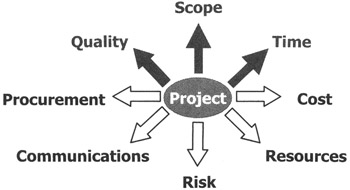
The three dimensions that we will consider in this type of optimization are quality, scope and time, as indicated by the solid black arrows in the illustration. When you try to decrease the duration of the project and trade-off against quality or scope, you are essentially doing an optimization on the dimension of time. The technique for this type of optimization is the Critical Path Method (CPM). Many project managers have gotten used to keeping their eye on the cost and resources while crashing the Critical Path, but we will not do that. We will discuss the CPM here in its original form, since we discuss including cost on page 466 (Optimizing for Time and Cost) and resources on page 472 (Optimizing for Time, Cost and Resources).

Techniques

  • The Critical Path Method (CPM)

    The CPM is a beautiful product of human logic. The beauty lies in the fact that it really helps project managers meet their deadlines by highlighting the tasks that are most likely to affect the project deadline. Finding and highlighting that series of tasks in your schedule is known as the Critical Path Method. A critical task does not have buffer time (slack), and any delay experienced on a critical task means your project end date will slip. The CPM uses a single duration estimate for each task.

  • The PERT Method

    The Program Evaluation and Review Technique ( PERT) technique is a more sophisticated application of the CPM. Instead of...

UNLIMITED FREE
ACCESS
TO THE WORLD'S BEST IDEAS

SUBMIT
Already a GlobalSpec user? Log in.

This is embarrasing...

An error occurred while processing the form. Please try again in a few minutes.

Customize Your GlobalSpec Experience

Category: Project Management Services
Finish!
Privacy Policy

This is embarrasing...

An error occurred while processing the form. Please try again in a few minutes.