Dynamic Scheduling With Microsoft Office Project 2003: The Book by and for Professionals

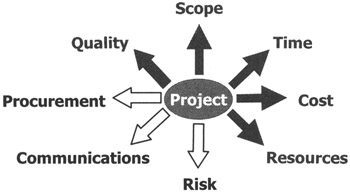
The next black arrow in the illustration is the dimension resources. We add it to the ones we already monitor: quality, scope, time and cost. Inclusion of the resources means that we will start monitoring the workload of the resources relative to their availability. If you find that the limited availability (or unavailability) of resources affects the forecast dates, you are in a resource-constrained or resource-limited situation. In this case, you need to include resources in your optimization. If you don't, your schedule will be too optimistic.

The resource dimension may make trade-offs with:
Cost, when you have to pay for extra resources or pay more for overtime
Time, when you cannot solve over-allocations in any other way than by delaying tasks
In this section, we will only discuss how to trade off between time and resources to keep the discussion simple. If you also need to bring down the cost of your project at the same time, you should consider the methods discussed in optimizing for time and cost (see page 468).
The optimization becomes more complex, but if we manage to handle this complexity, we will have confidence that the project is feasible as far as the resources are concerned. This will increase the validity of our forecasts.
As the steps in the process chart show, the first thing we have to do is resource workload leveling