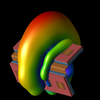
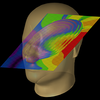
As mentioned earlier, solids are the most informationally complete and least ambiguous of the modeling types. It is easier to edit a complex solid shape than to edit wireframes and meshes.
You create solids from one of the basic solid shapes: box, cone, cylinder, polysolid, pyramid, sphere, torus, or wedge. The user-defined solids can be created by extruding or revolving 2D objects and regions to define a 3D solid. In addition, you can create more complex solid shapes by combining solids together by performing a Boolean operation UNION, SUBTRACTION, or INTERSECTION.
Solids can be further modified by filleting and chamfering their edges. AutoCAD provides commands for slicing a solid into two pieces or obtaining a 2D cross-section of a solid.
Like meshes, solids are displayed as a wireframe until you hide, shade, or render them. AutoCAD provides commands to analyze solids for their mass properties (volume, moments of inertia, center of gravity, etc.). AutoCAD allows you to export data about a solid object to applications such as NC (numerical control) milling and FEM (finite element method) analysis. If necessary, you can use the AutoCAD EXPLODE command to explode solids into mesh and wireframe objects.
| Note | The ISOLINES system variable controls the number of tessellation lines used to visualize curved portions of the wireframe. The default value for ISOLINES is set to 4. |
CREATING A SOLID BOX
The BOX command creates a solid box or cube. The base of the box is defined parallel to the...

 TABLE OF CONTENTS