HDL Programming Fundamentals: VHDL and Verilog
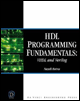
Teaching students the essentials of HDL and the functionality of the digital components of a system, this book includes several comprehensive projects to show HDL in practical application.
 TABLE OF CONTENTS
 In This Chapter
Understand the concept of sequential statements and how they differ from concurrent statements.
Identify the basic statements and components of behavioral descriptions, such as process, variable assignment statements, if, case, casex, casez,when, report, loop, exit, next, always, repeat, forever, and initial.
Review and understand the basics of digital logic systems such as D flip-flop, JK flip-flop, binary counters, and shift register.
Understand the concept of some basic genetic and renal systems.
Both VHDL and Verilog descriptions are discussed.
In Chapter 2, "Data-Flow Descriptions," data-flow simulations were implemented to describe digital systems for known digital structures, such as adders, multiplexers, and latches. The behavioral description is a powerful tool to describe systems for which the digital logic structures are not known or are hard to generate. Examples of such systems are complex arithmetic units, computer control units, and biological mechanisms that describe the physiological action of certain organs, such as the kidney or heart.
The behavioral description describes the system by showing how the outputs behave according to changes in the inputs.
In this description, we do not need to know the logic diagram of the system; what must be known is how the output behaves in response to change in the input.
In VHDL, the major behavioral description statement is process. In Verilog, the major behavioral description statements are always and initial.
For VHDL, the statements inside the process are sequential. In Verilog, all statements are...