HDL Programming Fundamentals: VHDL and Verilog
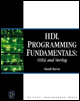
Teaching students the essentials of HDL and the functionality of the digital components of a system, this book includes several comprehensive projects to show HDL in practical application.
 TABLE OF CONTENTS
 Synchronous sequential circuits are called "state machines." The main components of the state machine are latches and flip-flops; additional combinational components may also be present. Synchronous clock pulses are fed to all flip-flops and latches of the machine. There are two types of synchronous sequential circuits: Mealy and Moore circuits. The output or next state of Mealy circuits depends on the inputs and the present state of the flip-flops/latches. The output or next state of the Moore circuit depends only on the present states. Present state and next state for a particular flip-flop are the same pin (output Q). The current state is the value of Q just before the present clock pulse or edge; the next state is the value of Q after the clock pulse or the edge. To analyze a state machine, we perform the following steps:
Determine the number of states. If the system is n-bit, then the number of flip-flops is n. The number of flip-flops here is calculated according to the "classical method," where the number of flip-flops is the minimum possible. Another method in which each state is represented by one flip-flop is frequently used because analysis of the system is easier than when using the classical method. For example, if the system is 3-bit, then the classical method requires three flip-flops, while the one flip-flop per state requires eight flip-flops. In this chapter, the classical method is implemented.
Construct a state diagram that shows the transition between...