HDL Programming Fundamentals: VHDL and Verilog
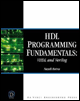
Teaching students the essentials of HDL and the functionality of the digital components of a system, this book includes several comprehensive projects to show HDL in practical application.
 TABLE OF CONTENTS
 In This Chapter
Understand the concept of describing and simulating digital systems using transistors.
Identify the basic statements of switch-level description in Verilog, such as nmos, pmos, cmos, supply1, supply0, tranif0, tran, and tranif0.
Develop a counterpart VHDL switch-level package that matches the switch-level functions of the Verilog description.
Review and understand the fundamentals of transistors, and how they can be implemented as switches.
Review Boolean functions for combinational circuits.
Switch-level description implements switches (transistors) to describe relatively small-scale digital systems.
Switch-level description is usually implemented in Very Large-Scale Integrated (VLSI) circuit layouts.
Switch-level description is the lowest HDL logic level that can be used to simulate digital systems.
Only small-scale systems can be simulated using pure switch-level description. If the system is not small, a huge number of switches are needed that may render the simulation impractical.
Switch-level description is routinely used along with other types of modeling to describe digital systems.
The switches used in this chapter are assumed to be perfect; they are either open (high impedance) or closed (zero impedance).
In contrast to Verilog, basic VHDL does not have built-in statements such as nmos, pmos, and cmos. To use these statements in VHDL, user-built packages must be developed.
Valence electrons: Electrons in the outer shell of the atom that can interact with the valence electrons of another atom.
N-type semiconductor: The free carriers are negatively charged electrons.
P-type semiconductor: