NURBS: From Projective Geometry to Practical Use, Second Edition

Chapter 3: Conics

Overview

Conics are the ancestors of all NURBS. By studying conics, we can observe most of the basic NURBS principles.

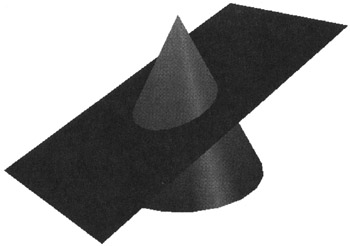
The classical definition generates conics as the intersections of a cone with a plane. One then obtains the familiar ellipses, hyperbolas, and parabolas. In projective geometry, this distinction is nonexistent, as is demonstrated in Fig. 3.1. There, the tip of the (double) cone is at the origin of three-space, and the cone is intersected with a 3D plane to yield a conic section in three-space. This conic section is projected into the plane z = 1, yielding yet another conic section. But we might have intersected our cone with any other plane, yielding a different conic section in three-space, and the projection would again be the same conic in the z = 1 plane! This is the reason informally stated why in projective geometry, we cannot distinguish between different types of conics.


Figure 3.1: Conic sections the classical definition intersects a cone with planes.

3.1 Line and Point Conics

We will not use the above approach to conics, but rather follow an approach that is due to J. Steiner:

Let ? be a projectivity that maps the line L onto another line M. We generate a line X by taking a point x on L, constructing its image = ? x, and by connecting the two points:

(3.1)

The collection of all such lines X is called...

UNLIMITED FREE
ACCESS
TO THE WORLD'S BEST IDEAS

SUBMIT
Already a GlobalSpec user? Log in.

This is embarrasing...

An error occurred while processing the form. Please try again in a few minutes.

Customize Your GlobalSpec Experience

Category: Surface Metrology Equipment
Finish!
Privacy Policy

This is embarrasing...

An error occurred while processing the form. Please try again in a few minutes.