7.4 Degree Reduction
In general, we will not be able to lower the degree of a given rational B zier curve. For example, a cubic, which might have an inflection point, cannot be written as a rational quadratic, because a conic cannot have an inflection point. The process of degree reduction will therefore be approximative. For the special case of approximating a rational cubic by a rational quadratic, see section 8.1.
We will choose to perform degree reduction in projective space there, we only have to deal with polynomials. Our aim is therefore the following: given a B zier curve b( t) with control vertices b i; i= 0, ..., n, find a B zier curve  ( t) with control vertices
  ; i = 0, ..., n - 1 that approximates the first curve. Several methods exist for this purpose, although they have all been developed in a Euclidean context. They can all be cast in the following setting.
Let us pretend that the b i were obtained from the  by the process of degree elevation (this is not true, in general, but makes a good working assumption). Then they would be related by
| (7.17) | 
|
This equation can be used to derive two recursive formulas for the generation of the  from the b i:
| (7.18) | 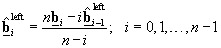
|
and
| (7.19) | 
|
The  perform satisfactorily near b 0, whereas the
  do well near b n. It seems a good idea therefore,...


 TABLE OF CONTENTS