NURBS: From Projective Geometry to Practical Use, Second Edition
Chapter 13: Quadrics

Overview

The most fundamental curves in the projective plane are the conics. As it turned out, they can be represented by projective quadratic B zier curves. Conversely, every projective B zier curve represents a conic.

For surfaces, life is not that easy. The fundamental surfaces in projective space are the quadrics but there is no one-to-one correspondence between them and any kind of B zier surface. In this chapter, we shall define quadrics, and then explore the relationship between quadrics and B zier surfaces.

13.1 Quadrics

A quadric in is a surface that has an implicit equation of the form

(13.1)

with x = [ x, y, z, w] T. A quadric has no more than two intersections with any straight line. Any planar section of a quadric is a conic. In fact, an alternative definition of a quadric is as being a surface all of whose planar sections are conics.

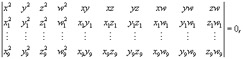
A quadric is defined by nine points on it. The implicit form takes on the form

(13.2)

much in the same way as (4.26) described a conic through five points.

Let a, b, c be any three noncollinear points on a quadric. They form a plane P, which cuts a conic ? out of the quadric. The tangent planes at a, b, c cut tangents to ? out of P, see Fig. 13.1. The three points a, b, c together with...

UNLIMITED FREE
ACCESS
TO THE WORLD'S BEST IDEAS

SUBMIT
Already a GlobalSpec user? Log in.

This is embarrasing...

An error occurred while processing the form. Please try again in a few minutes.

Customize Your GlobalSpec Experience

Category: Surface Metrology Equipment
Finish!
Privacy Policy

This is embarrasing...

An error occurred while processing the form. Please try again in a few minutes.