NURBS: From Projective Geometry to Practical Use, Second Edition

While the projective treatment of conics reveals most of their fundamental properties in an elegant way, "real world" applications of conies happen in an affine environment. In this chapter, we will thus shift our emphasis from the projective treatment of conies to an affine viewpoint. [1]
In the projective plane
, a conic may be described by a quadratic B zier curve:
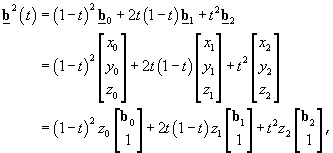
where the b i are already written as affine points:
| (5.1) | |
We can now project our projective curve b 2( t) into the (extended) affine plane, yielding the rational quadratic form of a conic:
| (5.2) | |
The (affine) points b i are called control points, and the z i are called weights.
The projective shoulder tangent T(
) is mapped to the tangent T(
) of the affine conic; the points q i are mapped to affine points q i:
| (5.3) | |
Because of their dependence on the weights, we call the q i weight points. The relation between weights and weight points is given by
For the definition of ratios, see Section 2.7.
In the affine case, the signs of the weights are of considerable importance; we will require that they are all of the same sign. To see why this is desirable, let us investigate the case of z 0 being negative, while z 1 and z 2 are positive. Referring to Fig. 5.1, we see that...