NURBS: From Projective Geometry to Practical Use, Second Edition

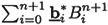
A projective B zier curve
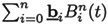
of degree n may be expressed as a B zier curve
of degree n + 1. The control points
are given by
| (7.14) | |
This is seen by multiplying
by [ t + (1 - t)] and comparing powers of t i and (1 - t) n +1- i.
We can project this into affine space, and obtain the degree elevation formulas for rational B zier curves:
| (7.15) | |
| (7.16) | |
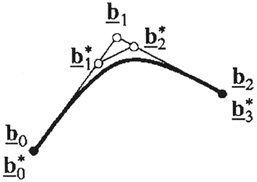
Fig. 7.8 gives an example of a conic that is degree elevated to rational cubic form.
We may degree elevate a rational B zier curve repeatedly, resulting in a sequence of weights and control polygons. Provided that all weights are of the same sign, the control polygons will converge to the curve. This follows from the corresponding results for polynomial curves, see [49] or [57].
We proved (7.14) by multiplying the equation of a B zier curve by the "harmless" constant 1, written as 1 = [ t + (1 - t)] But we may multiply b( t)by any other nonzero function ?( t), and would not change its shape! The function ? may be polynomial, thus raising the degree of the original curve. If ? has zeroes, we will introduce base points, see Section 7.7.