NURBS: From Projective Geometry to Practical Use, Second Edition
In projective space, b( t) may be evaluated by a projective de Casteljau algorithm:
| (7.7) | |
with
( t) = b i. Then
( t) = b( t) is the point with parameter value t. Fig. 7.6 illustrates the cubic case n = 3. [4] This de Casteljau algorithm is also defined in
; there it yields polynomial B zier curves for more details, see [57]. If we introduce
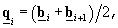
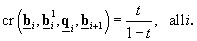
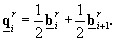
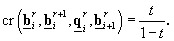
we observe that
Just as we did to prove (4.6), we can define
| (7.8) | |
and obtain that
| (7.9) | |
As a consequence,
| (7.10) | |
This shows that the projective de Casteljau algorithm (7.7) is projectively invariant: the point
( t) can be found by intersections and cross ratio constructions only. The points q i are, of course, the projective pre-images of the weight points q i.
We could also project every step of the projective de Casteljau algorithm into
and obtain the rational de Casteljau algorithm:
| (7.11) | |
with
( t) = b i and
. Then
( t) = b( t) is the point with parameter value t. Here, care must be taken in the case of t being outside the interval [0, 1], as some of the intermediate values may be vectors! [5] Example 7.1 illustrates this: the...