7.8 Derivatives
The derivative of a rational function seemingly involves the quotient rule; but we will avoid its use just as we did in the conic case. So we define p by
| (7.27) | 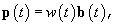
|
where w( t) is the denominator of the rational B zier curve b( t). Following the steps in Section 5.4, we obtain for the derivative  ( t):
( t):
| (7.28) | 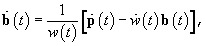
|
the dot denoting differentiation with respect to t. For the first derivatives at the endpoints of a rational B zier curve, we find
| (7.29) | 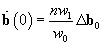
|
and
| (7.30) | 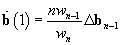
|
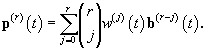
For higher derivatives, we differentiate (7.27) r times:
We can solve for b ( r )( t):
| (7.31) | 
|
This is a recursive formula for the r th derivative of a rational B zier curve. It only involves taking derivatives of polynomial curves, thus avoiding the quotient rule all together.
It is also possible to compute derivatives using the rational de Casteljau algorithm(7.11). We then obtain
| (7.32) | 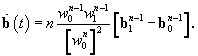
|
For a proof, see Floater [72]. Note that we do have to carry out the full rational de Casteljau algorithm; we could compute everything in projective space, up to r = n - 1, that is. Then we project into affine space so that we can apply (7.32).
For some algorithms, it is useful to know an upper bound for the derivative (the hodograph) of a curve. Sederberg and Wang [140] give the bound
| (7.33) | 
|
Floater [72] gives
| (7.34) | 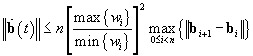
|
and notes that neither bound is sharper than...


 TABLE OF CONTENTS