NURBS: From Projective Geometry to Practical Use, Second Edition
Chapter 10: Pythagorean Curves

In this chapter, we will be firmly rooted in Euclidean geometry. The curves we are going to discuss all satisfy a property that makes some associated vectors be of unit length, for example, tangent vectors.

10.1 Circles and the Stereographic Projection

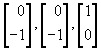
A well-known parametrization of the circle may be obtained as follows. Consider a unit circle with center at the origin of a Euclidean coordinate system. We can write the southeast quarter as a rational quadratic with control points


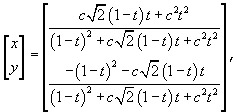
and standard weights 1, ,1. We may also reparametrize this circle representation, using a reparametrization constant c. [1] The equation then becomes

(10.1)

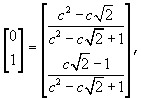
with c = 1 for the familiar standard form. Let us try to arrange the parametrization such that the curve passes through n = [0,1] T, the north pole of the circle, for t = ?. This leads to


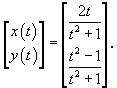
from which we deduce . We may then take the reparametrized B zier form (10.1) and rewrite it as follows:

(10.2)

Check that x 2( t) + y 2( t) = 1!

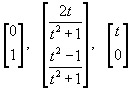
This parametrization is an example of the stereographic projection: the line through the north pole n and [ x( t), y( t)] T intersects the x-axis in x = t. This is seen by checking that the three points


are collinear.

Thus every point on the x-axis has a unique image point on the circle and...

UNLIMITED FREE
ACCESS
TO THE WORLD'S BEST IDEAS

SUBMIT
Already a GlobalSpec user? Log in.

This is embarrasing...

An error occurred while processing the form. Please try again in a few minutes.

Customize Your GlobalSpec Experience

Category: GPS Chips and Modules
Finish!
Privacy Policy

This is embarrasing...

An error occurred while processing the form. Please try again in a few minutes.