NURBS: From Projective Geometry to Practical Use, Second Edition
We have so far covered the basic theoretical aspects of conies in the projective plane. Our definition was based on the concept of projectivities between lines or pencils we will now use that concept for a more tangible description. This will be the parametric form, which will allow us to trace curves, and also to calculate derivatives. We will spend some time on parametric conies, as they are important by themselves, but also since many of their properties will carry over very naturally to rational B zier curves or to NURBS.
Before we start to treat conies in parametric form, we present a few facts about parametric curves in projective space; some phenomena arise here that are quite different from the more familiar affine treatment of curves.
A parametric curve x(t) is a map from the projective line endowed with a parameter t into
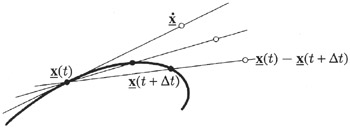
. Let us consider the derivative of x( t). We assume that each of the components of x is differentiable with respect to t. Let ? t be a nonzero number. Then the three collinear points x( t), x( t + ? t), x( t + ? t) - x( t) are on a secant of the curve, as shown in Fig. 4.1.