NURBS: From Projective Geometry to Practical Use, Second Edition

7.7: Base Points

7.7 Base Points

What happens if all components of a projective B zier curve vanish simultaneously, yielding an expression of the form b( t) = 0, clearly meaningless? In this situation, the corresponding parameter value t is called a base point. Thus a base point is a parameter value that does not map to a unique point in the range.

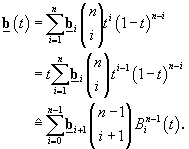
Let us study the case t = 0 instead of the general case. This is no restriction since we may employ subdivision (see Section 7.10) to make any point on a curve correspond to t = 0. If we have a base point for t = 0, then it follows that b = 0 and our B zier curve reduces to


This has to be interpreted as follows: the base point reduced the degree of the curve by one. For t = 0, the curve now starts at b 1 instead of b 0.

For any curve in projective space, base points may be introduced by multiplying by an arbitrary function ?( t) - recall that this does not change the shape of the curve. So replacing b( t) by ?( t) b( t) results in base points at every zero of ?( t). If ? is a rational polynomial, then so is ?( t) b( t), but now with base points present. Such...

UNLIMITED FREE
ACCESS
TO THE WORLD'S BEST IDEAS

SUBMIT
Already a GlobalSpec user? Log in.

This is embarrasing...

An error occurred while processing the form. Please try again in a few minutes.

Customize Your GlobalSpec Experience

Category: GPS Chips and Modules
Finish!
Privacy Policy

This is embarrasing...

An error occurred while processing the form. Please try again in a few minutes.