NURBS: From Projective Geometry to Practical Use, Second Edition

The theory of rational curves was an easy and straightforward extension of our treatment of conics. In the surface case, things will turn out to be more complicated. It would appear natural to base the development of surfaces on an extension of quadrics, but this is not possible. We therefore start with the parametric definition of a rational surface, shifting between affine and projective contexts as appropriate. We introduce rational B zier patches and NURBS just as we did for the curve case. Again, the B zier form is the basic building block, and we start from it.
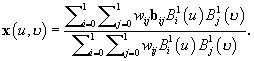
A point x( u, v) on a rational bilinear patch is the image a point ( u, v), defined by
| (11.1) | |
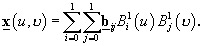
It may be viewed as a projection of bilinear polynomial patch in
, given by
| (11.2) | |
This patch is a map of a quadrilateral in the projective plane, defining a Moebius net as discussed in Section 1.5. The term bilinear is due to the fact that the patch equation is linear in u as well as in v. Geometrically, this means that the patch contains two families of straight lines: at a fixed point x( u *, v *), one line is given by
the other one by
These two lines span a plane, which is the tangent plane of our patch at ( u *, v *).
Fig. 11.1 illustrates. [1] Since intersecting straight lines...