7.6 Nonparametric Curves
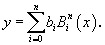
A functional, or nonparametric, integral B zier curve is defined by
It is easily represented in terms of a parametric B zier curve: its B zier points are given by b i = [ i/ n, b i] T. This works since the x coordinates satisfy
| (7.25) | 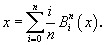
|
The situation in the rational case is somewhat more complicated. Let
| (7.26) | 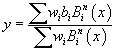
|
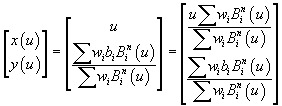
be a rational function of x. Can we write it as a parametric rational B zier curve, and if so, what are its B zier points b i and the corresponding weights v i? Written in parametric form, (7.26) takes the form
Using the identity  and degree elevation, we obtain
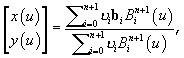
where
and
In the integral case, the abscissae i/ n of the B zier points of a functional B zier curve do not depend on the function; now they depend on the weights of the function under consideration. Thus a rational function y = a( x)/ b( x) with both a and b polynomials of degree n has a rational parametric representation of degree n + 1.
The abscissae iw i- 1/ v i are in the range [0, 1]. But note that they do not necessarily have to be increasing! For example, if the original weight sequence { w i} is 1, 10, 1, 10, then the abscissae sequence { iw i- 1/ v i} is 0, 1/31, 10/11,...


 TABLE OF CONTENTS