NURBS: From Projective Geometry to Practical Use, Second Edition

B zier triangles, short for triangular B zier patches, actually owe their discovery to P. de Casteljau from Citr en, who outlined their theory in the two technical reports [42] and [43]. Here, we are interested in their rational counterparts, but for the sake of simplicity, we start with an outline of integral, polynomial B zier triangles in projective space. These will then be projected onto their rational counterparts.
Triangular patches enjoy some popularity among CAGD researchers, although they have not been included in standards such as IGES. They are useful when it comes to modeling complex shapes that do not lend themselves to a rectangular topology. Rational B zier triangles have not been investigated very thoroughly yet; some pointers to the literature include [25], [84].
Before exploring rational B zier triangles, we introduce their projective pre-images triangular polynomial patches in .
, expressed in Bernstein-B zier form. They behave much like their integral (polynomial) counter-parts. For more complete information about integral B zier triangles, the reader is referred to [51] or [57].
A B zier patch in
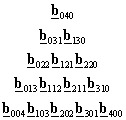
is defined by a control net similar to those of tensor product patches, except that it comes in a triangular arrangement. It is convenient to give each control point three subscripts, and a typical control net then looks like this:
Note how all subscripts sum to four this indicates that we are dealing with the control net of a degree four, or quartic, patch. For other degrees n, the arrangement is similar,...