7.1 The Bernstein Form
Any n th degree polynomial curve b( t) in  may be expressed in Bernstein form:
| (7.1) | 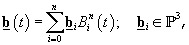
|
where the  are the Bernstein polynomials
| (7.2) | 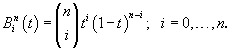
|
It is customary to add the following to this definition:
We note two important properties of Bernstein polynomials: they form a partition of unity:
| (7.3) | 
|
and they satisfy the recursion
| (7.4) | 
|
for more properties, see [57].
Figures 7.1, 7.2, and 7.3 give some examples of B zier curves in  ; the 3D cases have a similar flavor. We show the complete curves in most practical applications, one would only be interested in the segments "inside" the control polygon, i.e., those points corresponding to t ? [0, 1] in (7.1).
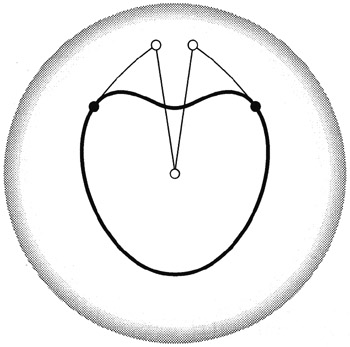 Figure 7.1: B zier curves a degree four (quartic) example.
 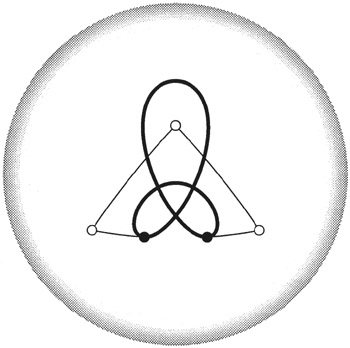 Figure 7.2: B zier curves another quartic example.
 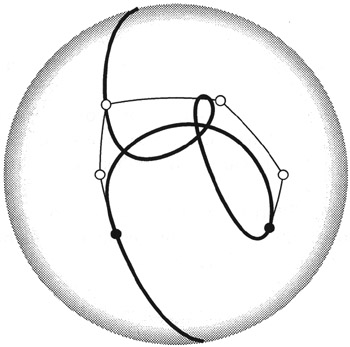 Figure 7.3: B zier curves a quintic example.
 We may project (7.1) into affine three-space: we will then obtain a rational B zier curve b( t). This follows the same development as that of rational quadratics in Section 5.1, and yields
| (7.5) | 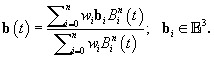
|
The w i are now called weights. If they are all positive, the curve lies in the convex hull of the control polygon b 0, ... , b n. [2] This is called the convex hull property of B zier curves.
If one weight, w k, say, is increased, the curve is "pulled" towards b k.
We can make a more precise statement as...


 TABLE OF CONTENTS