NURBS: From Projective Geometry to Practical Use, Second Edition

Chapter 14: Gregory Patches

Overview

Bicubic patches (integral ones) have enjoyed enormous popularity. Another type of surface, the Coons patch, never became quite as popular because of problems people had with a correct specification of certain twist vectors (see [57] for details.) The twist problem was first fixed by J. Gregory in 1972, still in the context of Coons patches. What really made his idea recognized and successful was, however, a modification by Chiyokura and Kimura as described in [33] and [32]. The following sections will focus on that approach; for the original literature, see Barnhill [14], Barnhill and Gregory [15], and Gregory [83]. [1]

J. Gregory has contributed more to the field of Geometric Modeling than just the patches that now bear his name. He also obtained fundamental results in the areas of interpolatory subdivision, n-sided patches, and shape preserving interpolation. John Gregory died in March 1993, at the age of 47.

[1]In the earlier literature, Gregory patches are typically referred to as "Gregory squares".

14.1 Bicubic Gregory Patches

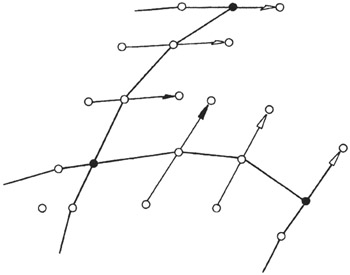
Consider the problem that is illustrated by Fig. 14.1: two (integral) bicubic B zier patches A and B are given. A third one is sought such that we achieve C 1 continuity across all patch boundaries.


Figure 14.1: Gregory patches the given data (solid circles) are incompatible.

The C 1 conditions between rectangular B zier patches determine all points in the desired patch with one exception: the pair of points marked by squares. Of those two, the point

UNLIMITED FREE
ACCESS
TO THE WORLD'S BEST IDEAS

SUBMIT
Already a GlobalSpec user? Log in.

This is embarrasing...

An error occurred while processing the form. Please try again in a few minutes.

Customize Your GlobalSpec Experience

Category: Bug Tracking Software
Finish!
Privacy Policy

This is embarrasing...

An error occurred while processing the form. Please try again in a few minutes.