NURBS: From Projective Geometry to Practical Use, Second Edition

Rational cubics are the simplest and most fundamental of all rational space curves. They are therefore important enough to warrant a whole chapter dedicated to their study alone. An excellent treatment of rational cubics is the one by Boehm[22]; another good reference is Forrest [77]. The more theoretically inclined reader will find valuable material in older books, such as [9] or [115].
While rational cubics are space curves in general, an important subclass are those rational cubics that are actually conics, and hence planar. In projective space, we may obtain a cubic from a quadratic (a conic) by the process of degree elevation.
In
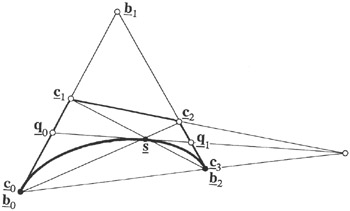
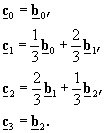
, consider Fig. 8.1. [1] Let b 0 , b 1 , b 2 be the original control points of the conic, and let c 0, c 1, c 2, c 3 be the control points of the corresponding cubic. They are related by
In affine space, the corresponding relationships are given by
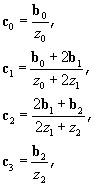
spelling out the more general equation (7.16). The weights w i of the cubic are then given by
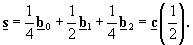
There is an interesting interplay between the quadratic and cubic forms. In projective space, we have
| (8.1) | |
For a proof, we write
from which deduce ? = ? =
. Thus
Let q 0 and q 1 be the intersections of the shoulder...