
AC Power Connectors Information

AC power connectors transfer alternating current through a variety of electronic devices and are used in a variety of commercial, industrial, and residential applications. AC power connectors range from simple AC inlets and outlets to sophisticated power entry modules that combine the functions of multiple electrical components into a single device. For example, some power entry modules serve as switches, fuses, filters, circuit breakers, and indicator lights.
Specifications
AC power connectors vary by gender, grounding, and configuration standards.
Several types of power connectors are available.
Plugs/inlets are male connectors which consist of the socket contacts. They connect to electrical receptacles, wall outlets, or sockets and draw current from these female connectors.
Receptacles/ outlets are also called jacks. They are the female or receiving connectors which mate to the male (plug) connectors.
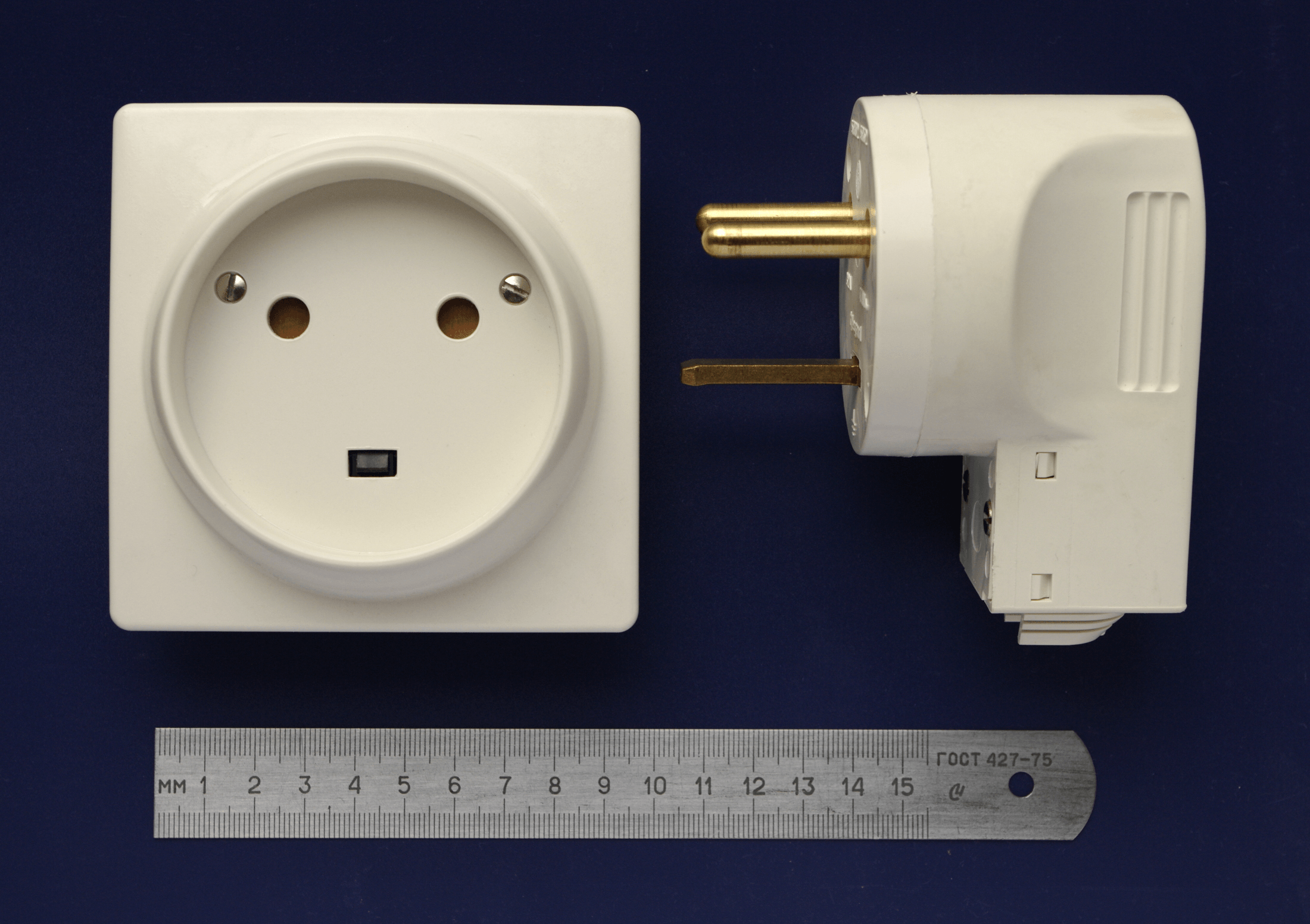
Outlet and plug. Image Credit: Wikipedia
Male connectors plug into female connectors such as outlets and jacks. Standard AC power connectors for computers have three prongs (the third prong is ground) and both a male end and a female end. The female end plugs into the computer, monitor, or other peripheral. The male end plugs into a surge-protected wall outlet. In terms of geometry, some AC power connectors are straight while others bend at a right angle.
Grounding
Mounting
There are many different mounting styles for AC power connectors.
Jam nut receptacles fit "D" shaped holes,
Cable end connectors fit the ends of electrical cables
In-line or cable receptacles fit panel cutouts.
Flange mounted connectors attach to panels by bolting the flange or riveting it in place through the two holes in the flange surface. Typically, wall or box receptacles are flanged, threaded through an accessory, and then mounted.

Flange mounted. Image Credit: RDI Inc.
Solder / weld mount receptacles are also designed for permanent mounting, but for higher-pressure systems. End launch connectors are soldered to the end or edge of printed circuit boards, and PC mount connectors are soldered into place via pre-drilled holes.
Surface mount connectors also require soldering, but do not use pre-drilled holes. SMT adds components to a printed circuit board (PCB) by soldering component leads or terminals to the top surface of the board. Typically, the PCB pad is coated with a paste-like formulation of solder and flux. With careful placement, SMT components on solder paste remain in position until elevated temperatures, usually from an infrared oven, melt the paste and solder the component leads to the PCB pads.
Terminals
AC power connectors provide many different ways to terminate electrical connections.
Cage clamps require very little preparation of the wire and no special tools. The terminal is inexpensive to install and offers a high degree of security.
Crimp is the physical compression (deformation) of a contact wire barrel around a conductor to make an electrical and mechanical connection to the conductor. There is a constant contact resistance as a result of precisely crimp connection quality. It is inexpensive and corrosion free as a result of cold weld action.
Screws provide an electrical termination that requires less space and no special tools.
Lugs are terminals used for crimping to large gauge cable and bolting to power or grounding sources.
Quick release tabs provide quick connection and termination.
Wire wraps are electrical connections made by wrapping a stripped or unstripped solid wire around a terminal post that contains a series of sharp edges. This solderless process requires a special wrapping tool.
Insulation displacement connectors(IDC) slice through the cable insulation to make a connection. Forcing an insulated conductor into a restrictive slot in the connection part of the contact displaces the insulation so that the bare wire engages the sides of the slot. IDCs are mass termination connectors for flat cables and eliminate the need to strip insulation.
In solder pin or PCB solder termination, electrical connection is made by soldering wires (pins) onto a printed circuit board (PCB). Solder cups are terminal ends or contacts into which conductors are inserted before soldering. A metal or metallic alloy is used to join metal surfaces together. Normally, a 60-40 rosin core (60% tin and 40% lead) is used for soldering electronic assemblies. Soldering is a wet process.
Through hole termination connects components mounted on printed circuit boards by inserting component leads through holes in the board and then soldering.
In pin termination, components are mounted on boards without soldering.
Features
Some AC power connectors are equipped with important safety features.
Ground fault interruption indicators (GFCI) detect problems with the ground connection and open the circuit for safety considerations. These indicators are commonly found on outlets and include a reset button.

GFCI outlet. Image Credit:Leviton
To protect against moderate spikes or peaks in electrical supply, some AC power connectors are equipped with integrated surge or fuse protection devices.
Some AC power connectors lock into place to prevent disconnection, or include a quick-mating geometry so that one connector can be disconnected quickly to connect to another machine or device. Connectors incorporate a quick-connect mating geometry, typically by twisting and seating for positive contact. They can be disconnected quickly and then easily connected to another machine or device.
Standards
Power connectors are designed to meet requirements from the
National Electrical Manufacturers Association (NEMA) - NEMA sets standards for electrical cabling and connectors.
The International Electrotechnical Commission (IEC)- IEC is a worldwide body responsible for developing consensus global standards in the electrotechnical field.
Consortium for Energy Efficiency (CEE) - CEE is a European organization for electrical standards.
Japanese Industrial Standards (JIS) - JIS is a Japanese organization for electrical standards.
There are many organizations across the world that determine and maintain electrical standards to ensure safe and efficient use of power plugs. GlobalSpec allows users to search by country to ensure they select a power connector that can be safely incorporated into their system.
Applications
Specialized power plugs are used for specific types of instruments, equipment, machinery, and computers. Some electrical connectors are designed for use in hazardous environments or marine environments. Power plugs are used in almost every industry including residential, commercial, industrial, and medical facilities.
As a rule, hospital grade connectors must meet especially stringent safety standards.
Resources
Image Credit:
LAppUSA
- 1 Pole
- 1-Wire
- 120/208 V
- 125/250 V
- 2 Poles
- 2-Wire
- 277/480 V
- 3 Poles
- 3-Wire
- 347/600 V
- 4 Poles
- 4-Wire
- 5 Poles
- 5-Wire
- Argentina
- British Isles
- Bulkhead Mounted
- CEE
- CSA Mark
- Cage Clamp
- Canada
- Commercial
- Crimp
- DIN Rail Mounted
- Denmark
- Flange Mounted
- Flush Mounted
- Fuse Protection
- GFCI
- Hospital
- IDC
- IEC
- In-Line / Cable End
- India
- Industrial
- Integral Switch
- International Rated
- Isolated Ground
- Israel
- Italy
- JIS
- Japan
- Locking
- Lugs
- Mexico
- NEMA
- NOM
- Non-Grounding
- North American Rated
- PCB Mounted
- PCB Solder
- Panel Mounted
- Plug / Inlet
- Quick Disconnect
- Receptacle / Outlet
- Residential / General-Purpose
- RoHS Compliant
- Screw
- Self-Grounding
- Single-Phase
- Solder Cup or Solder
- Standard Grounding
- Tabs
- Three-Phase
- UL Listing Mark
- USA
- VDE Component Mark
- WEEE Compliant
- Wire Wrap