
Insulated Gate Bipolar Transistors (IGBT) Information
Last revised: January 23, 2025
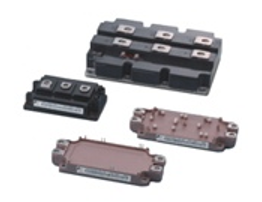
Insulated gate bipolar transistors (IGBTs) are semiconductors that combine a high voltage and high current bipolar junction transistor (BJT) with a low power and fast switching metal-oxide semiconductor field-effect transistor (MOSFET). Consequently, IGBTs provide faster speeds and better drive and output characteristics than power BJTs and offer higher current densities than equivalent high-powered MOSFETs.
Structurally, IGBTs feature a double diffusion of p-type and n-type regions. Applying a voltage to the gate contact forms an inversion layer under the gate. The p+ substrate layer serves as the drain, allowing the p-type region to fill the “holes” in the n-type drift region. The n+ buffer layer prevents the depletion region from extending to the bipolar collector, reducing on-state losses but drastically reducing the reverse blocking capability of the device.
Specifications
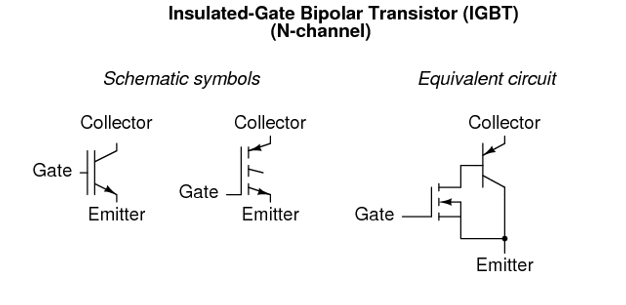
- Collector-emitter breakdown voltage
- Collector-emitter “on” or saturation voltage
- Maximum collector current
- Gate-emitter leakage current
- Rise time
- Fall time
- Switching speed
- Power dissipation
- Temperature
Features
- Output diodes
- Gate resistors
- Electrostatic discharge (ESD) protection
Other Specifications
- IGBT polarity can be n-channel or p-channel
- Punch-through and non-punch-through structures
- Specific temperature range
- Mechanical and electrical specifications that are suitable for commercial, industrial, or automotive applications
- Screening levels for military specifications (MIL-SPEC)
Package Types
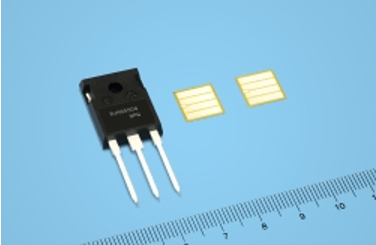
Transistor outline (TO) packages include TO-92, a single in-line package often used for low power devices; TO-220, which is suitable for high power, medium current, and fast-switching power devices; and TO-263, the surface-mount version of the TO-220 package.
Small outline transistor (SOT) packages include SOT23, which is often used in home appliances, office and industrial equipment, personal computers, printers, and communication equipment; SOT89, a plastic, surface mounted package with three leads and a collector pad for good heat transfer; and SOT223, an encapsulated package that provides excellent performance in environments with high temperatures and humidity levels.
IC package types for IGBTs also include discrete or deca-watt package (DPAK) and flat package (FPAK).
Packing Methods
The tape reel method packs components in a tape system by reeling specified lengths or quantities for shipping, handling, and configuration in industry-standard automated board-assembly equipment.
Rail, another standard packing method, is typically used only in production environments.
Bulk pack devices are distributed as individual parts, while tray components are shipped in trays.
The tube or stick magazine method is used to feed IGBTs into automatic placement machines for through-hole or surface mounting.
Standards
SAE PAPER 2001-01-1220 — Smart IGBT for advanced ignition systems
IGBTs FAQs
How do the different package types of IGBTs affect their thermal performance and reliability?
The different package types of IGBTs can significantly affect their thermal performance and reliability.
Package Types and Thermal Performance
TO-220 and TO-247 Packages: These are common through-hole packages used for high power applications. They allow for effective heat dissipation by attaching to external heat sinks, which is crucial for managing the thermal performance of IGBTs.
Surface Mount Technology (SMT) Packages: Packages like TO-263 are surface-mount versions that can be soldered with other components in one step, offering a cost advantage. However, cooling becomes more challenging as heat must be dissipated through the PCB.
Advanced Packaging Techniques: Innovations such as double-side sintering and wire bondless structures in packages like STO247 can significantly improve thermal management by allowing heat dissipation from both sides of the die, reducing die temperature by approximately 30%.
Reliability Considerations
Thermal Management: Effective thermal management is crucial for reliability. High junction temperatures and temperature gradients can induce mechanical stress, potentially leading to degradation or failure.
Package Design Enhancements: Improvements in package technology, such as optimizing bonding wire diameter and length, can enhance device reliability at high operating temperatures.
Material and Structural Innovations: The use of materials like silver sintering and redesigned epoxy mold compounds can support higher temperature operations, thus improving reliability.
Trade-offs and Considerations
Cost vs. Performance: While through-hole packages like TO-220 and TO-247 are cost-effective, they may not be suitable for applications requiring low stray inductance. Surface mount packages offer integration advantages but may require more sophisticated thermal management solutions.
Application-Specific Requirements: The choice of package type may depend on specific application requirements, such as automotive standards for creepage distance or the need for high power density in compact designs.
What is the impact of thermal management on IGBT reliability?
The impact of thermal management on the reliability of IGBTs is significant, as effective thermal management is crucial for maintaining device performance and longevity. Here are some key insights:
Thermal Management and Reliability
High Junction Temperatures: High temperatures at the junction of IGBTs can induce mechanical stress, especially at the interfaces of materials with different coefficients of thermal expansion. This stress can lead to degradation or even complete failure of the device.
Temperature Gradients: Large temperature gradients during operation can exacerbate mechanical stress, further impacting reliability.
Innovations in Thermal Management
Advanced Packaging Techniques: Techniques such as double-side sintering and wire bondless structures allow for improved thermal management by enabling heat dissipation from both sides of the die. This can reduce die temperature by approximately 30%, significantly enhancing reliability.
Material Innovations: The use of materials like silver sintering and redesigned epoxy mold compounds supports higher temperature operations, which can improve reliability by allowing the device to operate at higher temperatures without failure.
Design Considerations
Package Design Enhancements: Optimizing bonding wire diameter and length, as well as improving substrate materials, can enhance device reliability at high operating temperatures.
Cooling Solutions: Through-hole packages like TO-220 and TO-247 allow for effective heat dissipation by attaching to external heat sinks, which is crucial for managing thermal performance.
What are the latest innovations in IGBT packaging for improved thermal performance?
The latest innovations in IGBT packaging for improved thermal performance focus on advanced materials and structural designs that enhance heat dissipation and reliability. Here are some key innovations:
Double-Side Sintering and Wire Bondless Structures
This approach allows for heat dissipation from both sides of the die, significantly reducing die temperature by approximately 30%. This innovation enhances the reliability and performance of the IGBT by allowing for higher power density designs.
Silver Sintering
The use of silver sintering in IGBT packaging improves thermal management by providing a more efficient heat path, which is crucial for high-performance applications. This method also supports higher temperature operations, potentially up to 200° C.
Redesigned Epoxy Mold Compounds
Innovations in epoxy mold compounds allow for higher temperature operations, which contribute to improved thermal performance and reliability of the IGBT packages.
Optimized Package Design
Enhancements in package design, such as optimizing bonding wire diameter and length, and improving substrate materials, contribute to better thermal management and reliability at high operating temperatures.
What is the role of package types in thermal management of IGBTs?
The role of package types in the thermal management of IGBTs is crucial, as the package design directly influences the device's ability to dissipate heat and maintain reliability. Here are some key insights:
Package Types and Heat Dissipation
Through-Hole Packages (e.g., TO-220, TO-247): These packages are commonly used for high-power applications because they allow for effective heat dissipation by attaching to external heat sinks. This is essential for managing the thermal performance of IGBTs, as it helps to keep the junction temperature within safe limits.
Surface Mount Technology (SMT) Packages (e.g., TO-263): While these packages offer a cost advantage by allowing components to be soldered in one step, they present challenges in thermal management. Heat must be dissipated through the PCB, which can be more demanding compared to through-hole packages.
Innovations in Packaging for Thermal Management
Double-Side Sintering and Wire Bondless Structures: These advanced packaging techniques allow for heat dissipation from both sides of the die, reducing die temperature by approximately 30%. This significantly enhances the reliability and performance of the IGBT by supporting higher power density designs.
Silver Sintering and Redesigned Epoxy Mold Compounds: These material innovations improve thermal management by providing efficient heat paths and supporting higher temperature operations, which are crucial for high-performance applications.
Trade-offs and Considerations
Cost vs. Performance: While through-hole packages are cost-effective, they may not be suitable for applications requiring low stray inductance. Surface mount packages offer integration advantages but may require more sophisticated thermal management solutions.
Application-Specific Requirements: The choice of package type may depend on specific application requirements, such as automotive standards for creepage distance or the need for high power density in compact designs.
How do different package types affect the electrical performance of IGBTs?
The electrical performance of IGBTs is influenced by the package types in several ways. Here are some key insights based on the information available:
Stray Inductance
Through-Hole Packages (e.g., TO-220, TO-247): These packages are known to have a relatively large stray inductance, approximately 10 nH, which can lead to high dv/dt and voltage overshoots during switching events. This can result in extra losses and affect the electrical performance of the IGBT, particularly in high-frequency applications.
Surface Mount Technology (SMT) Packages (e.g., TO-263): These packages may offer lower stray inductance compared to through-hole packages, which can be beneficial for reducing switching losses and improving electrical performance in certain applications.
Voltage and Current Handling
The package type can influence the voltage and current handling capabilities of the IGBT. For instance, larger lead dimensions in certain packages can help reduce IR (current x resistance) drop, which is crucial for maintaining efficient electrical performance.
Thermal and Electrical Trade-offs
While through-hole packages like TO-220 and TO-247 are effective for thermal management, they may not be ideal for applications requiring low stray inductance. Conversely, SMT packages offer integration advantages but may require more sophisticated thermal management solutions to maintain electrical performance.
What is the impact of stray inductance on IGBT performance?
The impact of stray inductance on the performance of IGBTs is a critical consideration, particularly in high-frequency and high-power applications. Here are some key insights:
Stray Inductance and Switching Performance
Stray inductance in IGBT packages, such as TO-220 and TO-247, is typically around 10 nH. This can lead to high dv/dt (rate of voltage change over time) and voltage overshoots during switching events. These overshoots can cause additional losses and stress on the device, potentially affecting its performance and reliability, especially in high-frequency applications.
Impact on Electrical Performance
High stray inductance can result in increased switching losses, which can degrade the electrical performance of the IGBT. This is particularly problematic in applications where fast switching is required, as the inductance can limit the efficiency and effectiveness of the IGBT.
Package Type Considerations
Through-hole packages like TO-220 and TO-247, while effective for thermal management, may not be ideal for applications requiring low stray inductance. Surface mount technology (SMT) packages, such as TO-263, may offer lower stray inductance, which can be beneficial for reducing switching losses and improving electrical performance in certain applications.
IGBTs Media Gallery
References
GlobalSpec—Meeting the Demand for Smaller and More Reliable Power Modules with the X Series RC-IGBTs
Image credits:
Fuji Electric Corp. of America | All About Circuits | Renesas