The System Designer's Guide to VHDL-AMS: Analog, Mixed-Signal, and Mixed-Technology Modeling

With a contribution by Scott Cooper,
Mentor Graphics Corporation
This case study highlights VHDL-AMS as a mixed-technology, mixed-domain modeling language by focusing on the RC airplane rudder and servo control system (rudder system). We first implement the rudder system exclusively in the s-domain. After verifying top-level system requirements, we then refine most of the system to use conservation-based electromechanical components in which we model true physical characteristics of the system. Finally, we realize the servo compensator in the z-domain, so that it can be implemented as software rather than hardware.
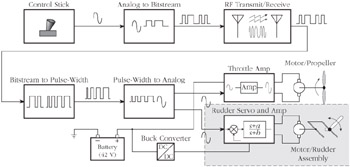
As noted in the Preface, the case studies revolve around a radio-controlled (RC) electric airplane system. This case study focuses on the rudder along with its servo controller, collectively referred to as the rudder system. Figure 14-1 shows the system diagram for the RC airplane system, with the rudder system indicated by the dashed box.
The RC airplane system is controlled with two channels, one for the propeller speed and the other for the rudder position. In a simple two-channel airplane system, the rudder controls the direction of the airplane. More advanced, multichannel airplanes control direction with ailerons, which cause the plane to bank in the desired direction. Since a simple two-channel plane has no ailerons to bank the plane, the rudder itself, in conjunction with dihedral wing design (where the tips of the wings are at a higher elevation than their base), causes the plane...