The System Designer's Guide to VHDL-AMS: Analog, Mixed-Signal, and Mixed-Technology Modeling

With a contribution by Scott Cooper,
Mentor Graphics Corporation
This first case study introduces the radio-controlled airplane system that will be thoroughly analyzed throughout the five case studies presented in this book. In this case study we focus on the encoding, transmission and decoding of the analog throttle and rudder command signals as they make their way to their respective end effectors. This portion of the system constitutes the "command and control" electronics for the airplane. We emphasize analog-to-digital (A/D) and digital-to-analog (D/A) signal conversions to illustrate mixed-signal modeling with VHDL-AMS.
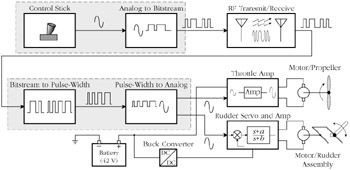
As noted in the Preface, the case studies revolve around a radio-controlled (RC) electric airplane system. The case studies illustrate the capabilities of the VHDL-AMS modeling language and include both mixed-signal and mixed-technology models. They also encompass several VHDL-AMS language features and embody clear guidelines for systems design and analysis. Figure 8-1 shows the system design for the RC airplane, with the command and control system highlighted by dashed boxes.
The command and control system electronics constitute much of the overall system. The radio frequency (RF) block, the servos and throttle/rudder mechanics and the 42 V power converter will be discussed in separate case studies. Figure 8-2 illustrates the command and control system in more detail. It is composed of four primary functional sections: analog control (the control stick blocks); digitization and encoding (the digitize/encode block); decoding and...