The System Designer's Guide to VHDL-AMS: Analog, Mixed-Signal, and Mixed-Technology Modeling

With a contribution by Scott Cooper,
Mentor Graphics Corporation
The RC airplane example illustrates the diverse capabilities of the VHDL-AMS modeling language. This system is implemented with a combination of analog, digital, mechanical and s-domain models. This final case study integrates the subsystems from Case Studies 1 to 4 into a complete airplane system. The following topics are highlighted: interfacing the command and control and rudder systems; analyzing system power supply effects; designing the propeller system; and implementing the human controller into the overall system.
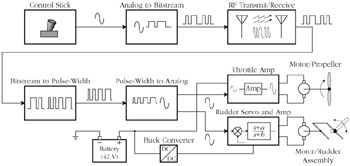
Figure 26-1 shows the complete system diagram for the RC airplane system. In previous case studies, we presented the specifications for the various subsystems. We summarize them in Figure 26-2 for reference. There are many ways in which to meet the specifications. For these case studies, we have chosen design avenues that lend themselves to reader education, occasionally in opposition to the most straightforward approach available. For example, a typical RC airplane system would probably use the 1-2 ms pulse outputs from the command and control blocks as the control signals for switching amplifiers that drive the rudder and propeller, rather than including extra data conversions as we have done.
| Command and Control System | |||
|---|---|---|---|
| Analog voltage input/output range | 0 4.8 V | Channel size | 16 bits |
| Digitization accuracy | 10 bits | Frame update rate | ~20 ms |
| Total number of channels | 8 | Output to servo, voltage pulse | 1 2 ms |
| Active channels | 2 |
| RF System |
|---|
| Carrier... |