The System Designer's Guide to VHDL-AMS: Analog, Mixed-Signal, and Mixed-Technology Modeling

With a contribution by Tom Egel,
Mentor Graphics Corporation
The purpose of the communication block is to transmit the encoded rudder and throttle commands to the airplane using frequency modulation (FM) techniques. This block constitutes both the ground-based transmitter and the in-flight receiver communication electronics. The key component in any communication system is the detector. In this case study, we consider two common detector architectures.
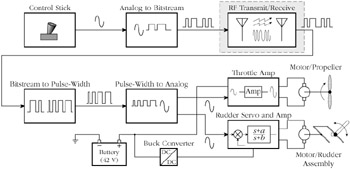
The RF communication system for the RC airplane is outlined by the dashed box in the system diagram in Figure 23-1. The main purpose of this block is to manipulate the digital bitstream so that it can be transmitted and received across the desired radio frequency channel. The RF block produces an output bitstream identical to the input bitstream under normal operation. The output bitstream is asynchronous with respect to the otherwise synchronous receiver electronics.
Figure 23-2, from [34], shows a basic model for a complete communication system. In a typical communication system, the source and destination are non-electrical. In the RC airplane, for example, the source is the joystick control and the destination is the rudder movement. As we saw in the first case study in Chapter 8, two transducers convert the source information (namely, joystick movements) into electrical signals. These signals are then encoded and multiplexed into a single digital bit-stream. The bitstream is modulated onto a high-frequency carrier so that it can be transmitted across the RF...