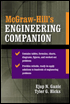
McGraw-Hill's Engineering Companion

Chapter 1: Engineering Units

DIMENSIONS AND UNITS

There are as many dimensions as there are kinds of physical quantities. Each new physical quantity gives rise to a new dimension. There can be only one dimension for each physical quantity.

A unit is a particular amount of the physical quantity. There are infinite possibilities for choosing a unit of a single physical quantity. All the possible units of the same physical quantity must be related by purely numerical factors.

Derived units are algebraic combinations of base units with some of the combinations being assigned special names and symbols.

SYSTEMS OF UNITS

There are still several systems of common units in use throughout the world. Transition from the others to Syst me International d'Unit s (International System of Units), or SI, will proceed at a rational pace to accommodate the needs of the professions or industries involved and the public. The transition period will be long and complex, and duality of units probably will be demanded for at least a decade after the change is introduced.

1 SI Units.

In October 1960, the Eleventh General (International) Conference on Weights and Measures redefined some of the original metric units and expanded the SI system to include other physical and engineering units.

The Metric Conversion Act of 1975 codifies the voluntary conversion of the United States to the SI system. It is expected that in time all units used in the United States will be in SI. For that reason, this chapter includes tables showing SI units,...

UNLIMITED FREE
ACCESS
TO THE WORLD'S BEST IDEAS

SUBMIT
Already a GlobalSpec user? Log in.

This is embarrasing...

An error occurred while processing the form. Please try again in a few minutes.

Customize Your GlobalSpec Experience

Category: Intercoms
Finish!
Privacy Policy

This is embarrasing...

An error occurred while processing the form. Please try again in a few minutes.