McGraw-Hill's Engineering Companion

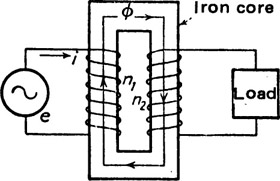
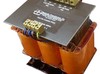
Figure 16.47 shows an iron core on which two windings are placed. The primaly winding has n 1 turns; the secondary winding has n 2 turns. If an alternating voltage e is impressed on the primary, a current i 1 will flow. This current causes flux ? in the core of the transformer. Moreover, since the voltage and hence the current in the primary are alternating, the flux ? will alternate. But the flux threads both the primary and secondary windings. Hence in both primary and secondary windings a voltage e 2 is induced of such magnitude that
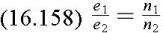
Dividing Eq. (16.157a) by Eq. (16.157b),
Virtually, e i is equal to the applied voltage e. Moreover, Eq. (16.158) states that any desired ratio of primary to secondary voltage can be obtained merely by varying the ratio of the number of turns n 1 and n 2 in the primary and secondary. A trans-fanner is therefore a device which is used to transform the voltage from high to low, or vice versa.
According to the law of conservation of power,
Thus while the ratio of primary to secondary voltage varies directly as the number of turns, the ratio of primary to secondary current varies inversely as the number of turns.
Generally speaking, in a powerhouse where electricity is generated, transformers are used to step up the voltage to a...