McGraw-Hill's Engineering Companion

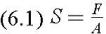
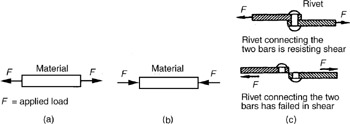
If a bar with a cross-sectional area of A is acted upon by two equal and oppositely directed axial forces F, F, the load per unit area, called the unit stress S, is given by the expression
If the forces are acting toward each other, the stress is compression and is denoted by S c. If the forces are acting away from each other, the stress is tension and is denoted by S t.
If two equal and oppositely directed forces F, F, are applied normal to the axis of a bar and in different planes of action, the part of the bar between the planes of action of the forces is subjected to a shearing action in which any cross section tends to slide over the one next to it. Unit shearing stress is denoted by S s. The shearing stress is not uniform across the cross section, but the average unit stress is given by the expression S s, = F/A. (See Fig. 6.1.)
Elasticity is the ability of a material to return to its original dimension after the removal of stresses. Nearly all of the materials used in engineering work are elastic, and within certain limits obey fairly well Hooke's law of...