McGraw-Hill's Engineering Companion

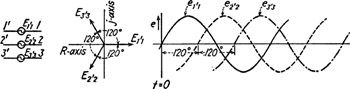
A three-phase emf source is one having three distinct emf's. Such a three-phase source is said to be balanced when (1) the three emf's have the same effective values, and (2) the vectors representing these emf's are equally displaced from each other by 2 ?/3 radians or 120 degrees. The three emf sources, their waves, and the vectors representing them are shown in Fig. 16.24. Commercial three-phase systems are approximately balanced, and this condition is assumed in the following sections.
Three-phase sources may be connected either in star (Y) or in mesh ( ?). Each of these types of connection is defined below.
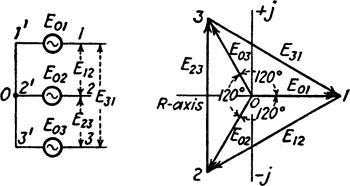
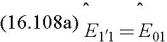
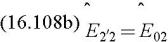
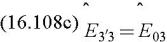
Star or Y Connection. Let the terminals 1 ?, 2 ?, and 3 ? of the emf sources be connected together as in Fig. 16.25. Call the common terminal 0. The voltages then become
The vectors representing these emf's are also shown in Fig. 16.25. The Y connection is so named because of the shape of this vector diagram.
The emf's given in Eq. (16.108) are known as phase emf's. If a voltmeter is connected across the terminals 12, 23, and 31 (Fig. 16.25), respectively, it will read what is known as the line emf's E 12, E 23, and E 31. The vector relation between the line and phase emf's is obtained directly from Fig.