McGraw-Hill's Engineering Companion

The subject of electronics can be approached from the standpoint of the design of devices or the use of devices. For the practicing engineer, describing devices in terms of their external characteristics seems most likely to be profitable. The approach will be to describe devices as they appear to the outside world.
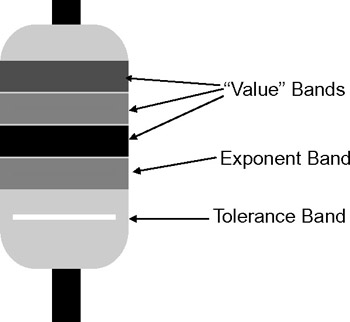
Resistors normally have a series of four or five color bands printed on them as shown in Fig. 17.1. These bands are used to specify the resistance of the circuit using the formula:
Table 17.1 lists the values for each band color and what they mean in the resistance specification formula.
| >Number | Color | Band1 | Band2 | Band3 | Exponent Band | Tolerance Band |
|---|---|---|---|---|---|---|
| 0 | Black | N/A | 0 | 0 | 10 ** 0 | N/A |
| 1 | Brown | 1 | 1 | 1 | 10 ** 1 | 1% Tolerance |
| 2 | Red | 2 | 2 | 2 | 10 ** 2 | 2% Tolerance |
| 3 | Orange | 3 | 3 | 3 | 10 ** 3 | N/A |
| 4 | Yellow | 4 | 4 | 4 | 10 ** 4 | N/A |
| 5 | Green | 5 | 5 | 5 | 10 ** 5 | 0.5% Tolerance |
| 6 | Blue | 6 | 6 | 6 | 10 ** 6 | 0.25% Tolerance |
| 7 | Violet | 7 | 7 | 7 | 10 ** 7 | 0.1% Tolerance |
| 8 | Gray | 8 | 8 | 8 | 10 **8 | 0.05% Tolerance |
| 9 | White | 9 | 9 | 9 | 10 ** 9 | N/A |
| N/A | Gold | N/A | N/A | N/A | 10 ** ?1 | 5% Tolerance |
| N/A | Silver | N/A | N/A | N/A | 10 ** ?2 |