McGraw-Hill's Engineering Companion

Thermodynamics The branch of science that embodies the principles and restrictions of energy transformation in macroscopic systems.
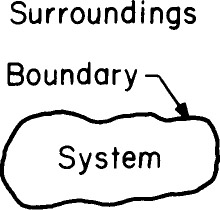
System and Surroundings A system is taken to be any quantity of matter under consideration (or any object or region associated with the quantity of matter under consideration) selected for study and set apart (imaginary) from everything else, the latter then being called the surroundings (Fig. 7.1).
Boundary The imaginary envelope which encloses the system and separates it from its surroundings is called the boundary of the system. With a closed system there is no interchange of matter through the boundary between the system and its surroundings. With an open system there is such an interchange (Fig. 7.2). An isolated system can exchange neither matter nor energy with its surroundings.
Processes Any change that the system may undergo is known as a process. Engineering thermodynamics considers chiefly those processes in which energy transformation occurs by means of changes in the physical state of fluids. The processes are classified into either reversible or irreversible. Another classification is nonflow and steady flow processes.
A reversible process is one in which both the system and the surroundings may be returned to their original states. With an irreversible process, this is not possible. All actual processes are irreversible. Among the conditions which contribute to the irreversibility of a process are the following: heat flow from a higher...