McGraw-Hill's Engineering Companion

Chapter 11: Topics in Applied Physics

ELECTRIC FIELDS

1 Electric Charge.

Any observed charge q, positive or negative, is in magnitude an integral multiple of


where ? e is the charge on a single electron. Note that C (coulomb) is the derived unit for electric charge, since 1 C = 1 A s. One coulomb is a large amount of charge; hence the microcoulomb ( ?C) is frequently used.

An electric current in a wire corresponds to the transport of a certain amount of electric charge through a fixed cross section in a certain time interval. Electric current is measured in amperes (A).

2 Coulomb's Law.

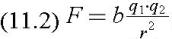
If q 1 and q 2 are magnitudes of two charges, separated by a distance r, then the force between them is


This force is repulsive when q 1 and q 2 are of the same sign and attractive when they are of opposite signs. By experiment, it is found that


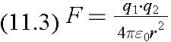
For mathematical reasons, it is convenient to replace b by another constant, ? 0, called the permissivity of empty space and defined by


In terms of ? 0, Coulomb's law is written


Forces between point charges act independently. Suppose that charges q 1, q 2, q 3, are fixed in an inertial frame. Then the force F 1 on a charge due to q 1 is computed by Coulomb's law as if q 2, q 3,

UNLIMITED FREE
ACCESS
TO THE WORLD'S BEST IDEAS

SUBMIT
Already a GlobalSpec user? Log in.

This is embarrasing...

An error occurred while processing the form. Please try again in a few minutes.

Customize Your GlobalSpec Experience

Category: Ionizers and Static Eliminators
Finish!
Privacy Policy

This is embarrasing...

An error occurred while processing the form. Please try again in a few minutes.